Ch. 12 - Radicals
Bruice - Organic Chemistry 8th Edition
Bruice8th EditionOrganic ChemistryISBN: 9780135213711Not the one you use?Change textbook
Chapter 13, Problem 22a(3,4)

Draw the major product(s) of the reaction of 1-methylcyclohexene with the following reagents, disregarding stereoisomers:
3. HBr
4. HBr/peroxide

Verified step by step guidance
1
Identify the structure of 1-methylcyclohexene. It is a cyclohexene ring with a double bond and a methyl group attached to one of the carbons in the double bond.
For reaction 3 (HBr): Recognize that this is a hydrohalogenation reaction. The double bond will react with HBr, and the reaction will proceed via Markovnikov's rule. This means the hydrogen (H) will add to the carbon in the double bond with more hydrogens already attached, and the bromine (Br) will add to the carbon with fewer hydrogens.
Draw the intermediate carbocation formed during the reaction with HBr. The more stable carbocation (secondary or tertiary) will form, as carbocation stability influences the reaction pathway.
For reaction 4 (HBr/peroxide): Recognize that the presence of peroxide changes the reaction mechanism to a free radical addition. This reaction proceeds via anti-Markovnikov's rule, where the bromine (Br) adds to the carbon in the double bond with more hydrogens, and the hydrogen (H) adds to the carbon with fewer hydrogens.
Draw the major product(s) for both reactions, keeping in mind the regioselectivity (Markovnikov for HBr and anti-Markovnikov for HBr/peroxide). Disregard stereoisomers as instructed.

Verified video answer for a similar problem:

This video solution was recommended by our tutors as helpful for the problem above.
Video duration:
3m
Was this helpful?

Key Concepts

Here are the essential concepts you must grasp in order to answer the question correctly.

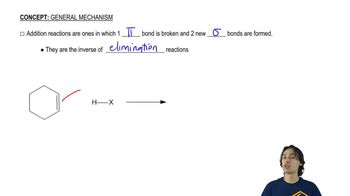
Electrophilic Addition Reactions

Electrophilic addition reactions involve the addition of an electrophile to a nucleophile, typically across a double bond. In the case of alkenes like 1-methylcyclohexene, the π bond acts as a nucleophile, reacting with electrophiles such as HBr. This process leads to the formation of a more stable carbocation intermediate, which can then react with a nucleophile to form the final product.
Recommended video:
Guided course
05:39
Features of Addition Mechanisms.

Markovnikov's Rule

Markovnikov's Rule states that in the addition of HX (where X is a halogen) to an alkene, the hydrogen atom will attach to the carbon with the greater number of hydrogen atoms already attached. This rule helps predict the major product of the reaction, as it favors the formation of the more stable carbocation, leading to the most substituted alkyl halide as the final product.
Recommended video:
Guided course
03:54
The 18 and 16 Electron Rule

Radical Mechanism in Peroxide Reactions

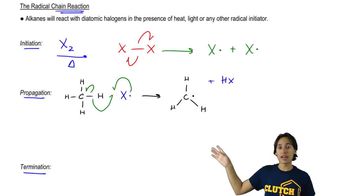
The presence of peroxides in reactions with HBr leads to a radical mechanism, which differs from the typical electrophilic addition. In this case, the reaction proceeds via the formation of bromine radicals that add to the alkene, resulting in anti-Markovnikov products. This mechanism is crucial for understanding how the presence of peroxides alters the regioselectivity of the reaction.
Recommended video:
Guided course
12:11
Radical Chain Reaction Mechanism.