Ch. 12 - Radicals
Bruice - Organic Chemistry 8th Edition
Bruice8th EditionOrganic ChemistryISBN: 9780135213711Not the one you use?Change textbook
Chapter 13, Problem 9b

Would chlorination or bromination produce a greater yield of 2-halo-2,3-dimethylbutane?

Verified step by step guidance
1
Understand the reaction: The problem involves halogenation (chlorination or bromination) of 2,3-dimethylbutane. Halogenation occurs via a free radical mechanism, and the yield of a specific product depends on the reactivity and selectivity of the halogen used.
Recall the reactivity-selectivity principle: Chlorine is more reactive but less selective, while bromine is less reactive but more selective. This means chlorination can produce a variety of products, while bromination tends to favor the formation of the most stable product.
Identify the most stable radical intermediate: In the halogenation of 2,3-dimethylbutane, the tertiary carbon (C2) forms the most stable radical due to hyperconjugation and inductive effects. Bromination will predominantly yield 2-bromo-2,3-dimethylbutane because it selectively reacts at the tertiary carbon.
Analyze the product distribution: Chlorination, being less selective, will produce a mixture of products, including 2-chloro-2,3-dimethylbutane and other isomers. Bromination, due to its high selectivity, will produce a higher yield of 2-bromo-2,3-dimethylbutane compared to chlorination producing 2-chloro-2,3-dimethylbutane.
Conclude the comparison: Bromination will produce a greater yield of 2-halo-2,3-dimethylbutane because it selectively reacts at the tertiary carbon, whereas chlorination produces a mixture of products due to its lower selectivity.

Verified video answer for a similar problem:

This video solution was recommended by our tutors as helpful for the problem above.
Video duration:
4m
Was this helpful?

Key Concepts

Here are the essential concepts you must grasp in order to answer the question correctly.

Halogenation

Halogenation is a chemical reaction that involves the substitution of hydrogen atoms in an organic compound with halogen atoms (such as chlorine or bromine). This process is crucial in organic chemistry for synthesizing haloalkanes, which are important intermediates in various chemical reactions. The reactivity and selectivity of halogens can significantly influence the yield of the desired product.
Recommended video:
Guided course
03:45
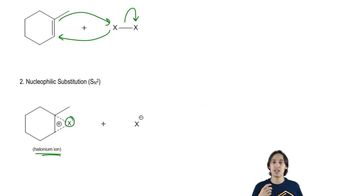
Halogenation Mechanism

Selectivity of Halogens

The selectivity of halogens refers to their tendency to preferentially react with certain positions in a molecule. Chlorine is generally more reactive than bromine, leading to a higher likelihood of multiple substitutions and potentially lower selectivity. In contrast, bromination is more selective, often resulting in fewer by-products and a higher yield of the desired haloalkane, especially in complex molecules like 2-halo-2,3-dimethylbutane.
Recommended video:
Guided course
03:45
Halogenation Mechanism

Reaction Mechanism

The reaction mechanism describes the step-by-step process by which reactants are converted into products. In the case of halogenation, mechanisms can include free radical pathways, where the halogen reacts with the alkane to form radicals. Understanding the mechanism helps predict the outcome of the reaction, including the yield and the distribution of products, which is essential for determining whether chlorination or bromination will produce a greater yield of 2-halo-2,3-dimethylbutane.
Recommended video:
Guided course
02:16
Heck Reaction Mechanism