Ch. 12 - Radicals
Bruice - Organic Chemistry 8th Edition
Bruice8th EditionOrganic ChemistryISBN: 9780135213711Not the one you use?Change textbook
Chapter 13, Problem 8a

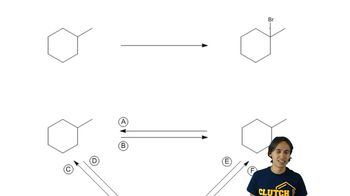
What is the major product of the reaction in Problem 7 when the alkane reacts with Cl2 instead of with Br2? Disregard stereoisomers.

Verified step by step guidance
1
Identify the type of reaction: The reaction involves the halogenation of an alkane with Cl₂, which proceeds via a free radical substitution mechanism. This mechanism includes initiation, propagation, and termination steps.
Understand the reactivity of chlorine: Chlorine is more reactive and less selective than bromine in free radical halogenation. This means that chlorine will react with all types of hydrogen atoms (primary, secondary, and tertiary) but will favor the most abundant hydrogens due to its lower selectivity.
Analyze the structure of the alkane: Determine the number and types of hydrogens (primary, secondary, tertiary) present in the alkane. This will help predict the possible sites for substitution.
Predict the major product: Since chlorine is less selective, the major product will depend on both the reactivity of the hydrogen atoms and their abundance. Calculate the relative likelihood of substitution at each type of hydrogen by considering both the reactivity and the number of hydrogens available.
Write the structure of the major product: Replace one hydrogen atom at the most likely substitution site with a chlorine atom to form the major product. Disregard stereoisomers as instructed in the problem.

Verified video answer for a similar problem:

This video solution was recommended by our tutors as helpful for the problem above.
Video duration:
6m
Was this helpful?

Key Concepts

Here are the essential concepts you must grasp in order to answer the question correctly.

Halogenation of Alkanes

Halogenation is a reaction where alkanes react with halogens (like Cl2 or Br2) to form alkyl halides. This process typically involves a free radical mechanism, where the halogen molecule dissociates into two halogen radicals, which then abstract hydrogen atoms from the alkane, leading to the formation of a halogenated product.
Recommended video:
Guided course
02:47
Functionalizing Alkanes

Selectivity of Halogens

Different halogens exhibit varying selectivity in their reactions with alkanes. Chlorination (with Cl2) tends to produce a mixture of products due to its higher reactivity and less selectivity compared to bromination (with Br2), which favors the formation of more stable products. Understanding this selectivity is crucial for predicting the major product in halogenation reactions.
Recommended video:
Guided course
03:45
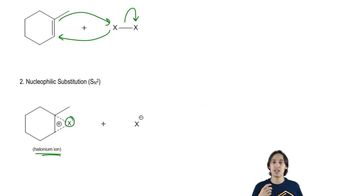
Halogenation Mechanism

Radical Stability

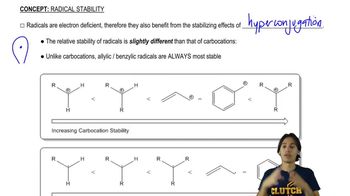
The stability of the radical intermediates formed during halogenation significantly influences the product distribution. Tertiary radicals are more stable than secondary or primary radicals, leading to preferential formation of products that result from the abstraction of hydrogen from more substituted carbons. This concept is essential for predicting the major product when alkanes react with halogens.
Recommended video:
Guided course
03:43
The radical stability trend.