Ch. 11 - Organometallic Compounds
Bruice - Organic Chemistry 8th Edition
Bruice8th EditionOrganic ChemistryISBN: 9780135213711Not the one you use?Change textbook
Chapter 12, Problem 26

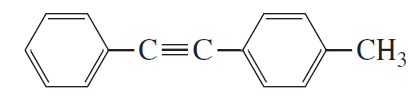
What new products are obtained from metathesis of the following alkyne?
Structural representation of an alkyne with two phenyl groups and a methyl group, illustrating a metathesis reaction.

Verified step by step guidance
1
Step 1: Identify the alkyne structure provided in the image. The molecule contains a triple bond between two carbon atoms, with substituents on either side. The substituents are an ethyl group on one side and an isopropyl group on the other side.
Step 2: Understand the concept of alkyne metathesis. Alkyne metathesis is a reaction where triple bonds are redistributed between alkyne molecules, typically catalyzed by metal-based catalysts such as molybdenum or tungsten complexes.
Step 3: Predict the products of the metathesis reaction. During metathesis, the triple bond is cleaved and reformed, leading to the exchange of substituents between the reacting alkyne molecules. This results in the formation of new alkynes with different substituent arrangements.
Step 4: Analyze the possible combinations of substituents. In this case, the ethyl and isopropyl groups can recombine with other fragments of the molecule, leading to the formation of two new alkynes. The products will depend on the redistribution of the substituents.
Step 5: Write the general structures of the new products. The new alkynes formed will have the triple bond between carbon atoms, with one product containing an ethyl group and another substituent, and the second product containing an isopropyl group and another substituent. The exact structures can be determined by considering the redistribution of substituents during the reaction.

Verified video answer for a similar problem:

This video solution was recommended by our tutors as helpful for the problem above.
Video duration:
4m
Was this helpful?

Key Concepts

Here are the essential concepts you must grasp in order to answer the question correctly.

Alkyne Structure

Alkynes are hydrocarbons that contain at least one carbon-carbon triple bond. This structure is characterized by the presence of sp-hybridized carbon atoms, which leads to linear geometry around the triple bond. Understanding the specific alkyne structure is crucial for predicting the products of reactions such as metathesis.
Recommended video:
Guided course
09:11
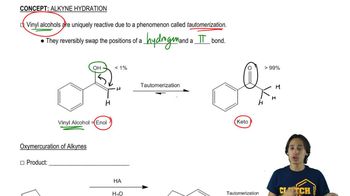
Alkyne Hydration

Metathesis Reaction

Metathesis is a chemical reaction that involves the exchange of partners between two reactants, typically involving alkenes or alkynes. In the context of alkynes, metathesis can lead to the formation of new carbon-carbon bonds, resulting in different alkyne or alkene products. This reaction is facilitated by catalysts, often involving transition metals.
Recommended video:
2:09
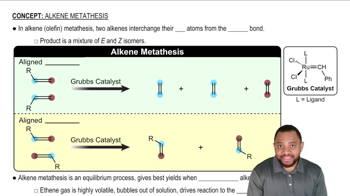
Alkene Metathesis Concept 1

Catalysts in Organic Reactions

Catalysts are substances that increase the rate of a chemical reaction without being consumed in the process. In organic chemistry, catalysts such as transition metal complexes are often used in metathesis reactions to facilitate the breaking and forming of bonds. Understanding the role of catalysts is essential for predicting the efficiency and outcome of metathesis reactions.
Recommended video:
1:22
Introduction to Catalysis Example 1