Ch. 11 - Organometallic Compounds
Bruice - Organic Chemistry 8th Edition
Bruice8th EditionOrganic ChemistryISBN: 9780135213711Not the one you use?Change textbook
Chapter 12, Problem 9a

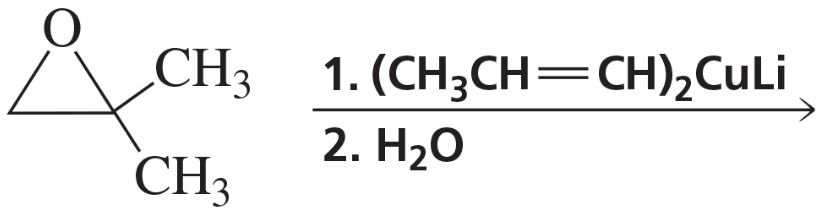
What are the products of the following reactions?
a.

Verified step by step guidance
1
Step 1: Identify the reactants and reagents. The starting material is an epoxide (a three-membered cyclic ether), and the reagents are an organocuprate (R2CuLi) followed by water (H2O). Organocuprates are nucleophiles that can open epoxides under mild conditions.
Step 2: Determine the regioselectivity of the epoxide opening. Organocuprates typically attack the less substituted carbon of the epoxide due to steric hindrance and electronic effects. This results in the cleavage of the C-O bond.
Step 3: Analyze the nucleophilic attack. The organocuprate (CH3CH2CuLi) will donate one of its alkyl groups (CH3CH2-) to the less substituted carbon of the epoxide, forming a new C-C bond. The oxygen atom remains attached to the more substituted carbon.
Step 4: Consider the second step of the reaction. After the nucleophilic attack, the intermediate is treated with water (H2O). Water protonates the oxygen atom, converting it into a hydroxyl group (-OH).
Step 5: Write the final product structure. The product will be a molecule with a hydroxyl group (-OH) on the more substituted carbon and an ethyl group (CH3CH2-) attached to the less substituted carbon of the original epoxide.

Verified video answer for a similar problem:

This video solution was recommended by our tutors as helpful for the problem above.
Video duration:
1m
Was this helpful?

Key Concepts

Here are the essential concepts you must grasp in order to answer the question correctly.

Organometallic Reagents

Organometallic reagents, such as organolithium and Grignard reagents, are compounds containing a carbon-metal bond. They are highly reactive and are commonly used in organic synthesis to form new carbon-carbon bonds. In the reaction shown, the organometallic reagent reacts with a carbonyl compound, facilitating nucleophilic addition to form an alcohol after hydrolysis.
Recommended video:
Guided course
02:50
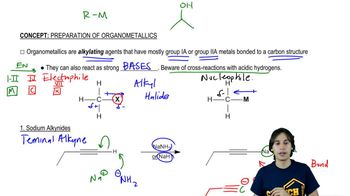
Ruining Organometallics

Nucleophilic Addition

Nucleophilic addition is a fundamental reaction mechanism in organic chemistry where a nucleophile attacks an electrophilic carbon atom, typically found in carbonyl groups. This process leads to the formation of a new bond and is crucial in the synthesis of alcohols from carbonyl compounds. The reaction depicted involves the nucleophilic attack of the organometallic reagent on the carbonyl carbon.
Recommended video:
Guided course
08:27
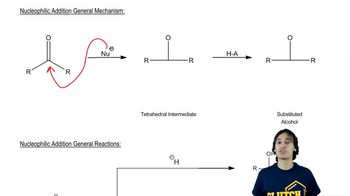
Nucleophilic Addition

Hydrolysis

Hydrolysis is a chemical reaction involving the breakdown of a compound due to the reaction with water. In organic chemistry, hydrolysis often follows the formation of an intermediate product, converting it into a stable product, such as an alcohol. In the given reaction, after the nucleophilic addition, the addition of water leads to the hydrolysis of the intermediate, yielding the final alcohol product.
Recommended video:
1:00
Hydrolysis of Thioesters Concept 2