Ch. 11 - Organometallic Compounds
Bruice - Organic Chemistry 8th Edition
Bruice8th EditionOrganic ChemistryISBN: 9780135213711Not the one you use?Change textbook
Chapter 12, Problem 8c

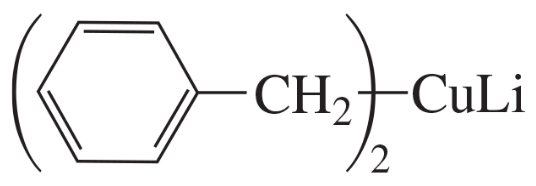
What alcohols are formed from the reaction of ethylene oxide with the following organocuprates followed by the addition of acid?
c.

Verified step by step guidance
1
Step 1: Understand the reaction mechanism. Ethylene oxide is an epoxide, a three-membered cyclic ether, which is highly reactive due to ring strain. Organocuprates (R₂CuLi) are nucleophiles that can open the epoxide ring via an SN2 mechanism, attacking the less substituted carbon of the epoxide.
Step 2: Identify the nucleophile. In this case, the organocuprate (R₂CuLi) provides an alkyl group (R⁻) that acts as the nucleophile. The nucleophile will attack the less hindered carbon of the ethylene oxide, breaking the C-O bond and opening the ring.
Step 3: Write the intermediate product. After the nucleophilic attack, the oxygen atom from the ethylene oxide will carry a negative charge, forming an alkoxide ion (R-CH₂-CH₂-O⁻).
Step 4: Add acid to the reaction. The alkoxide ion is then protonated by the addition of acid (H⁺), resulting in the formation of an alcohol. The final product will be R-CH₂-CH₂-OH, where R is the alkyl group from the organocuprate.
Step 5: Generalize the products. For each specific organocuprate, substitute the R group into the final alcohol structure (R-CH₂-CH₂-OH). For example, if the organocuprate is (CH₃)₂CuLi, the product will be CH₃-CH₂-CH₂-OH.

Verified video answer for a similar problem:

This video solution was recommended by our tutors as helpful for the problem above.
Video duration:
3m
Was this helpful?

Key Concepts

Here are the essential concepts you must grasp in order to answer the question correctly.

Ethylene Oxide Reactivity

Ethylene oxide is a cyclic ether that is highly reactive due to its strained three-membered ring structure. When it reacts with nucleophiles, such as organocuprates, it undergoes ring-opening to form alcohols. Understanding this reactivity is crucial for predicting the products formed in the reaction.
Recommended video:
Guided course
03:51
Reagents used to oxidize Sulfides.

Organocuprates

Organocuprates are organometallic compounds containing copper, typically used as nucleophiles in organic synthesis. They are formed by the reaction of lithium diorganocopper reagents with alkyl or aryl halides. Their ability to react with electrophiles, like ethylene oxide, is essential for forming new carbon-carbon bonds and generating alcohols.

Acid Workup

An acid workup is a common step in organic reactions that involves adding an acid to protonate intermediates or products, often to neutralize bases or to facilitate the formation of alcohols from alkoxides. In the context of the reaction with ethylene oxide, the acid workup helps to convert the alkoxide formed after nucleophilic attack into the corresponding alcohol.
Recommended video:
Guided course
01:31
Oxidative Workup Mechanism: