Ch. 10 - Reactions of Alcohols, Ethers, Epoxides, Amines, and Sulfur-Containing Compounds
Bruice - Organic Chemistry 8th Edition
Bruice8th EditionOrganic ChemistryISBN: 9780135213711Not the one you use?Change textbook
Chapter 11, Problem 45

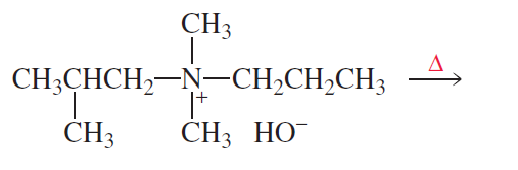
What are the minor products of the preceding Hofmann elimination reaction?
Chemical structure of an amine undergoing Hofmann elimination, showing reactants and heat symbol for reaction conditions.

Verified step by step guidance
1
Step 1: Recognize that the Hofmann elimination reaction involves the removal of a β-hydrogen from the least substituted β-carbon, leading to the formation of an alkene. The reaction proceeds via an E2 elimination mechanism.
Step 2: Analyze the structure of the quaternary ammonium salt provided. Identify the β-carbons (carbons adjacent to the α-carbon, which is bonded to the nitrogen atom). In this case, there are multiple β-carbons with hydrogens available for elimination.
Step 3: Determine the possible alkenes that can form by removing a β-hydrogen from each β-carbon. The major product will form from the least substituted β-carbon, but minor products can form from other β-carbons as well.
Step 4: Draw the structures of the minor alkenes that result from elimination at the more substituted β-carbons. These alkenes will have varying degrees of substitution and may include cis/trans isomers depending on the geometry of the double bond.
Step 5: Consider the stereochemistry and regioselectivity of the reaction. While the major product is dictated by Hofmann's rule (least substituted alkene), the minor products will include alkenes formed from elimination at the more substituted β-carbons. Ensure all possible minor products are accounted for.

Verified video answer for a similar problem:

This video solution was recommended by our tutors as helpful for the problem above.
Video duration:
2m
Was this helpful?

Key Concepts

Here are the essential concepts you must grasp in order to answer the question correctly.

Hofmann Elimination

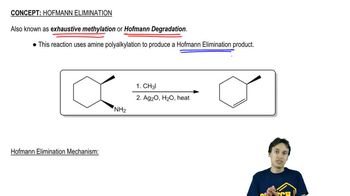
Hofmann elimination is a chemical reaction that involves the conversion of primary amines to alkenes through the formation of an N-alkylated amine intermediate. This process typically requires the use of a halogenating agent and a strong base, leading to the loss of an amine and the formation of an alkene. Understanding this reaction is crucial for predicting the products formed, including minor products that may arise from side reactions.
Recommended video:
Guided course
03:22
General Reaction

Minor Products

In organic chemistry, minor products are those that are formed in smaller quantities compared to the major products during a chemical reaction. These products can result from alternative reaction pathways or side reactions that occur alongside the primary reaction. Identifying minor products is important for a comprehensive understanding of the reaction mechanism and the overall product distribution.
Recommended video:
Guided course
11:07
Bridged-Products

Reaction Mechanism

A reaction mechanism describes the step-by-step sequence of elementary reactions by which overall chemical change occurs. In the context of Hofmann elimination, understanding the mechanism helps in predicting both major and minor products, as it outlines how reactants are transformed into products through various intermediates. This knowledge is essential for chemists to manipulate conditions to favor desired outcomes.
Recommended video:
Guided course
02:16
Heck Reaction Mechanism