Ch. 10 - Reactions of Alcohols, Ethers, Epoxides, Amines, and Sulfur-Containing Compounds
Bruice - Organic Chemistry 8th Edition
Bruice8th EditionOrganic ChemistryISBN: 9780135213711Not the one you use?Change textbook
Chapter 11, Problem 50a

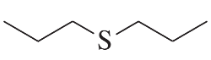
Using an alkyl halide and a thiol as starting materials, how would you prepare the following thioethers?
a.

Verified step by step guidance
1
Step 1: Recognize the target molecule as a thioether (sulfide), which has the general structure R-S-R'. In this case, both R and R' are ethyl groups (C2H5).
Step 2: Identify the starting materials. You need an alkyl halide and a thiol. For this synthesis, use ethyl bromide (C2H5Br) as the alkyl halide and ethanethiol (C2H5SH) as the thiol.
Step 3: Understand the reaction mechanism. This is a nucleophilic substitution reaction (SN2 mechanism). The thiol (C2H5SH) acts as a nucleophile, attacking the electrophilic carbon in the ethyl bromide (C2H5Br), displacing the bromide ion (Br⁻).
Step 4: Write the reaction equation: \( \text{C}_2\text{H}_5\text{SH} + \text{C}_2\text{H}_5\text{Br} \rightarrow \text{C}_2\text{H}_5\text{S}\text{C}_2\text{H}_5 + \text{HBr} \). This shows the formation of the thioether and hydrobromic acid as a byproduct.
Step 5: Ensure proper reaction conditions. Perform the reaction in a polar aprotic solvent (e.g., acetone or DMSO) to favor the SN2 mechanism. Use a mild base (e.g., NaOH or KOH) to deprotonate the thiol, increasing its nucleophilicity and facilitating the reaction.

Verified video answer for a similar problem:

This video solution was recommended by our tutors as helpful for the problem above.
Video duration:
1m
Was this helpful?

Key Concepts

Here are the essential concepts you must grasp in order to answer the question correctly.

Alkyl Halides

Alkyl halides are organic compounds containing a carbon atom bonded to a halogen atom (such as chlorine, bromine, or iodine). They are key intermediates in organic synthesis and can undergo nucleophilic substitution reactions, where the halogen is replaced by a nucleophile, such as a thiol, to form new compounds like thioethers.
Recommended video:
Guided course
01:52
How to name alkyl halides

Thiol Chemistry

Thiols are organic compounds that contain a sulfhydryl group (-SH). They are nucleophilic in nature, meaning they can donate a pair of electrons to form a bond with electrophiles, such as alkyl halides. In the synthesis of thioethers, thiols react with alkyl halides through nucleophilic substitution, resulting in the formation of thioether linkages.
Recommended video:
Guided course
03:21
The mechanism of Sulfide Synthesis.

Nucleophilic Substitution Mechanisms

Nucleophilic substitution is a fundamental reaction mechanism in organic chemistry where a nucleophile attacks an electrophile, leading to the replacement of a leaving group. There are two main types: SN1, which involves a two-step mechanism with carbocation formation, and SN2, which is a one-step process where the nucleophile attacks the electrophile simultaneously as the leaving group departs. Understanding these mechanisms is crucial for predicting the outcomes of reactions involving alkyl halides and thiols.
Recommended video:
Guided course
01:47
Nucleophiles and Electrophiles can react in Substitution Reactions.