Ch. 10 - Reactions of Alcohols, Ethers, Epoxides, Amines, and Sulfur-Containing Compounds
Bruice - Organic Chemistry 8th Edition
Bruice8th EditionOrganic ChemistryISBN: 9780135213711Not the one you use?Change textbook
Chapter 11, Problem 56d

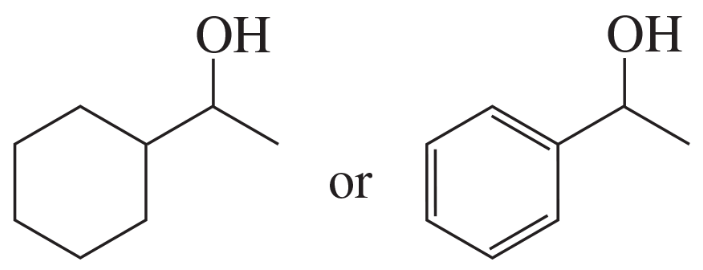
Indicate which alcohol in each pair undergoes an elimination reaction more rapidly when heated with H2SO4.
d.

Verified step by step guidance
1
Identify the structure of each alcohol in the pair. Look for the position of the hydroxyl group (-OH) and the degree of substitution of the carbon atom to which it is attached (primary, secondary, or tertiary).
Recall that the rate of elimination reactions, such as dehydration with H2SO4, is influenced by the stability of the carbocation intermediate. Tertiary carbocations are more stable than secondary, which are more stable than primary.
Determine the degree of substitution for each alcohol. Tertiary alcohols will generally undergo elimination more rapidly than secondary or primary alcohols due to the formation of a more stable carbocation.
Consider any additional factors that might influence the reaction rate, such as the presence of electron-donating or withdrawing groups that can stabilize or destabilize the carbocation.
Compare the two alcohols based on the above criteria and predict which one will undergo the elimination reaction more rapidly when heated with H2SO4.

Verified video answer for a similar problem:

This video solution was recommended by our tutors as helpful for the problem above.
Video duration:
3m
Was this helpful?

Key Concepts

Here are the essential concepts you must grasp in order to answer the question correctly.

Elimination Reactions

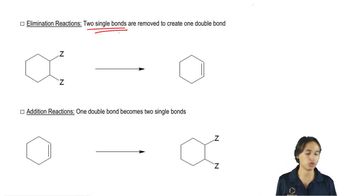
Elimination reactions involve the removal of a small molecule from a larger one, typically resulting in the formation of a double bond. In organic chemistry, these reactions often occur with alcohols when treated with strong acids like H2SO4, leading to the formation of alkenes. The rate of elimination can depend on the structure of the alcohol, such as whether it is primary, secondary, or tertiary.
Recommended video:
Guided course
00:40
Recognizing Elimination Reactions.

Zaitsev's Rule

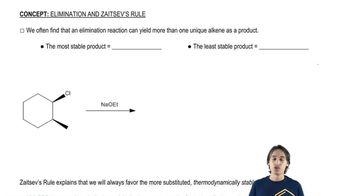
Zaitsev's Rule states that in elimination reactions, the more substituted alkene (the one with more alkyl groups attached to the double bond) is generally the major product. This principle helps predict the outcome of elimination reactions, as more stable alkenes are favored. Understanding this rule is crucial for determining which alcohol will undergo elimination more rapidly when heated with H2SO4.
Recommended video:
Guided course
01:18
Defining Zaitsev’s Rule

Acid-Catalyzed Dehydration

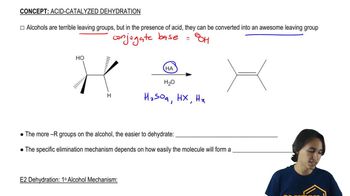
Acid-catalyzed dehydration is a specific type of elimination reaction where an alcohol loses a water molecule in the presence of an acid, such as sulfuric acid. This process typically involves protonation of the alcohol, followed by the loss of water and formation of a carbocation intermediate. The stability of the carbocation significantly influences the rate of the reaction, with tertiary carbocations being more stable and reactive than primary ones.
Recommended video:
Guided course
06:01
General features of acid-catalyzed dehydration.