Ch. 10 - Reactions of Alcohols, Ethers, Epoxides, Amines, and Sulfur-Containing Compounds
Bruice - Organic Chemistry 8th Edition
Bruice8th EditionOrganic ChemistryISBN: 9780135213711Not the one you use?Change textbook
Chapter 11, Problem 57a(9)

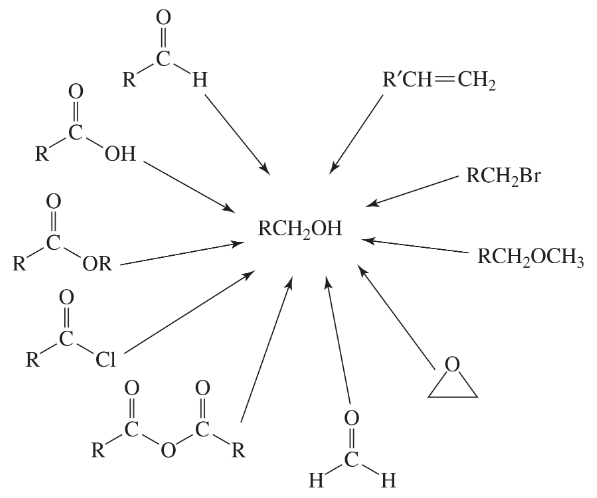
a. Show the reagents required to form the primary alcohol in each of the following reactions.

Verified step by step guidance
1
Identify the starting material and the product. The starting material is 1-bromobutane (C4H9Br), and the product is 1-butanol (C4H9OH), a primary alcohol.
Recognize that the transformation involves replacing the bromine atom (Br) with a hydroxyl group (OH). This is a nucleophilic substitution reaction.
Determine the type of nucleophilic substitution. Since the substrate is a primary alkyl halide, the reaction will proceed via the SN2 mechanism.
Select an appropriate nucleophile and solvent. Use hydroxide ion (OH⁻) as the nucleophile, which can be provided by a strong base like sodium hydroxide (NaOH) or potassium hydroxide (KOH). The reaction is typically carried out in an aqueous or aqueous-alcoholic solvent.
Write the reaction conditions: Heat the reaction mixture to promote the substitution reaction, as SN2 reactions often require mild heating to proceed efficiently.

Verified video answer for a similar problem:

This video solution was recommended by our tutors as helpful for the problem above.
Video duration:
2m
Was this helpful?

Key Concepts

Here are the essential concepts you must grasp in order to answer the question correctly.

Nucleophilic Substitution

Nucleophilic substitution is a fundamental reaction in organic chemistry where a nucleophile attacks an electrophilic carbon atom, replacing a leaving group. In this case, the bromide (Br) acts as the leaving group, and the hydroxide ion (OH-) serves as the nucleophile, leading to the formation of a primary alcohol.
Recommended video:
Guided course
01:47
Nucleophiles and Electrophiles can react in Substitution Reactions.

Reagents for Alcohol Formation

To convert an alkyl halide to an alcohol, specific reagents are required. For the reaction shown, the hydroxide ion (OH-) is typically provided by a strong base such as sodium hydroxide (NaOH) or potassium hydroxide (KOH). These reagents facilitate the nucleophilic attack on the carbon atom bonded to the bromine.
Recommended video:

Primary Alcohols

Primary alcohols are characterized by having the hydroxyl (-OH) group attached to a carbon atom that is bonded to only one other carbon atom. This structure influences their reactivity and properties, making them distinct from secondary and tertiary alcohols. Understanding the structure of primary alcohols is essential for predicting their behavior in chemical reactions.
Recommended video:
1:11
Primary Protein Structure Example 1