Ch. 1 - Remembering General Chemistry: Electronic Structure and Bonding (Part 2)
Bruice - Organic Chemistry 8th Edition
Bruice8th EditionOrganic ChemistryISBN: 9780135213711Not the one you use?Change textbook
Chapter 2, Problem 68

Rank the following compounds from highest dipole moment to lowest dipole moment:

Verified step by step guidance
1
Identify the molecular structure of each compound. Look for polar bonds, which are typically bonds between atoms with different electronegativities.
Determine the geometry of each molecule. The shape of the molecule will affect how the dipole moments of individual bonds add up to create a net dipole moment.
Evaluate the electronegativity differences in each bond. Larger differences in electronegativity typically result in stronger dipole moments.
Consider the symmetry of the molecule. Symmetrical molecules may have dipole moments that cancel out, resulting in a lower net dipole moment.
Rank the compounds based on the net dipole moment calculated from the above steps, from highest to lowest.

Verified video answer for a similar problem:

This video solution was recommended by our tutors as helpful for the problem above.
Was this helpful?

Key Concepts

Here are the essential concepts you must grasp in order to answer the question correctly.

Dipole Moment

The dipole moment is a measure of the separation of positive and negative charges in a molecule, indicating the polarity of the bond. It is a vector quantity, represented by the product of the charge and the distance between the charges. A higher dipole moment signifies a greater polarity, which affects the compound's physical properties, such as solubility and boiling point.
Recommended video:
Guided course
01:46
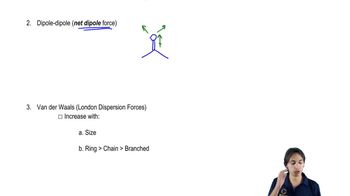
How dipole-dipole forces work.

Molecular Geometry

Molecular geometry refers to the three-dimensional arrangement of atoms within a molecule. The shape of a molecule influences how dipoles from individual bonds combine, determining the overall dipole moment. For example, symmetrical molecules may have bond dipoles that cancel out, resulting in a lower or zero net dipole moment, while asymmetrical molecules typically exhibit higher dipole moments.
Recommended video:
Guided course
07:44
Molecular Geometry Explained.

Electronegativity

Electronegativity is the tendency of an atom to attract electrons in a chemical bond. Differences in electronegativity between bonded atoms create polar bonds, contributing to the overall dipole moment of the molecule. Understanding the electronegativity values of the atoms involved helps predict the direction and magnitude of the dipole, which is essential for ranking compounds by their dipole moments.
Recommended video:
Guided course
1:47
Electronegativity