Ch. 1 - Remembering General Chemistry: Electronic Structure and Bonding (Part 2)
Bruice - Organic Chemistry 8th Edition
Bruice8th EditionOrganic ChemistryISBN: 9780135213711Not the one you use?Change textbook
Chapter 2, Problem 71

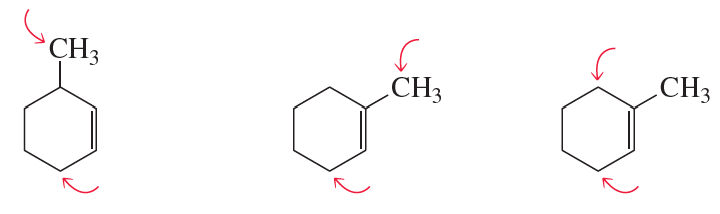
Do the sp2 carbons and the indicated sp3 carbons lie in the same plane?
Three benzene ring structures with methyl groups, showing different orientations and indicating sp2 and sp3 carbon positions.

Verified step by step guidance
1
Step 1: Understand the hybridization of the carbons in the molecule. sp2 carbons are trigonal planar, meaning their bonds and lone pairs lie in the same plane. sp3 carbons are tetrahedral, meaning their bonds are arranged in three-dimensional space.
Step 2: Analyze the molecular structure in image A. The sp2 carbons are part of the double bond in the ring, which is planar. The indicated sp3 carbons are connected to the ring via single bonds. Due to the tetrahedral geometry of sp3 carbons, their bonds do not necessarily lie in the same plane as the sp2 carbons.
Step 3: Examine the molecular structure in image B. The sp2 carbons are part of the conjugated double bonds in the ring, which are planar. The indicated sp3 carbons are attached to the ring via single bonds. The tetrahedral geometry of sp3 carbons causes their bonds to extend out of the plane of the sp2 carbons.
Step 4: Review the molecular structure in image C. The sp2 carbons are part of the double bond in the ring, which is planar. The indicated sp3 carbons are connected to the ring via single bonds. Similar to the previous cases, the tetrahedral geometry of sp3 carbons results in their bonds being out of the plane of the sp2 carbons.
Step 5: Conclude that in all three cases (A, B, and C), the sp2 carbons lie in a single plane due to their trigonal planar geometry, while the indicated sp3 carbons do not lie in the same plane due to their tetrahedral geometry.

Verified video answer for a similar problem:

This video solution was recommended by our tutors as helpful for the problem above.
Video duration:
3m
Was this helpful?

Key Concepts

Here are the essential concepts you must grasp in order to answer the question correctly.

Hybridization

Hybridization is the concept that describes the mixing of atomic orbitals to form new hybrid orbitals, which can explain the geometry of molecular structures. In organic chemistry, sp2 hybridization involves one s and two p orbitals, resulting in a trigonal planar arrangement, while sp3 hybridization involves one s and three p orbitals, leading to a tetrahedral geometry. Understanding these hybridizations is crucial for determining the spatial arrangement of atoms in a molecule.
Recommended video:
Guided course
10:43
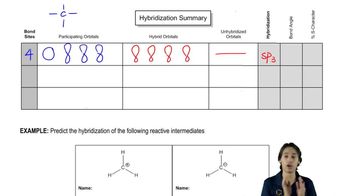
Using bond sites to predict hybridization

Molecular Geometry

Molecular geometry refers to the three-dimensional arrangement of atoms within a molecule. The geometry is influenced by the types of hybridization present; for example, sp2 hybridized carbons are typically found in a plane due to their trigonal planar shape, while sp3 hybridized carbons can adopt a tetrahedral shape, which may lead to non-planarity. Analyzing the geometry helps in predicting the interactions and reactivity of the molecules.
Recommended video:
Guided course
07:44
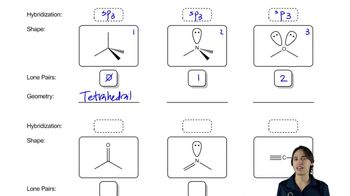
Molecular Geometry Explained.

Planarity in Organic Molecules

Planarity in organic molecules is determined by the hybridization of the carbon atoms and the presence of double bonds. sp2 hybridized carbons are generally planar due to their trigonal planar arrangement, while sp3 hybridized carbons can introduce angles that deviate from the plane. Understanding the planarity of different carbon types is essential for predicting molecular behavior, such as reactivity and steric interactions.
Recommended video:
Guided course
02:17
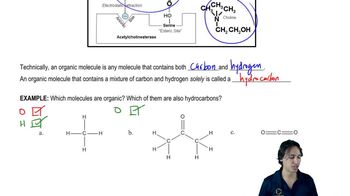
Identifying organic molecules