Ch. 1 - Remembering General Chemistry: Electronic Structure and Bonding (Part 1)
Bruice - Organic Chemistry 8th Edition
Bruice8th EditionOrganic ChemistryISBN: 9780135213711Not the one you use?Change textbook
Chapter 1, Problem 21

Which of the atoms in the molecular models in [Problem 20] have
<IMAGE>
a. three lone pairs?
b. two lone pairs?
c. one lone pair?
d. no lone pairs?

Verified step by step guidance
1
Step 1: Analyze the molecular models provided in the image. Each model highlights a specific atom (circled) for evaluation of lone pairs. Lone pairs are unshared electron pairs on an atom, and their count depends on the atom's valence electrons and bonding configuration.
Step 2: For part (a), identify atoms with three lone pairs. Typically, atoms like halogens or oxygen in certain configurations may have three lone pairs. Check the circled atoms in the models to see if any fit this criterion.
Step 3: For part (b), identify atoms with two lone pairs. Oxygen atoms in neutral molecules often have two lone pairs when bonded to other atoms. Examine the circled oxygen atoms in models C and D to determine if they have two lone pairs.
Step 4: For part (c), identify atoms with one lone pair. Nitrogen atoms in certain bonding configurations, such as in model B, may have one lone pair. Evaluate the circled nitrogen atom in model B to confirm this.
Step 5: For part (d), identify atoms with no lone pairs. Atoms like carbon in saturated hydrocarbons or positively charged nitrogen (as in model A) often have no lone pairs. Verify the circled nitrogen atom in model A and other atoms in the models to determine if they lack lone pairs.

Verified video answer for a similar problem:

This video solution was recommended by our tutors as helpful for the problem above.
Video duration:
3m
Was this helpful?

Key Concepts

Here are the essential concepts you must grasp in order to answer the question correctly.

Lone Pairs

Lone pairs are pairs of valence electrons that are not involved in bonding and are localized on a single atom. They play a crucial role in determining the geometry and reactivity of molecules. Understanding how to identify lone pairs in molecular structures is essential for predicting molecular behavior and interactions.
Recommended video:
Guided course
02:04
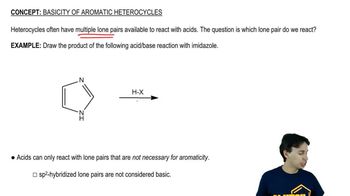
Heterocycles - Which lone pairs react?

Valence Electrons

Valence electrons are the outermost electrons of an atom and are responsible for forming bonds with other atoms. The number of valence electrons determines an atom's bonding capacity and its ability to form lone pairs. In organic chemistry, knowing the valence electron count for common elements like carbon, nitrogen, and oxygen is vital for analyzing molecular structures.
Recommended video:
Guided course
03:40
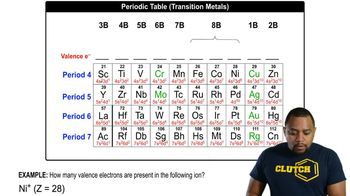
Valence Electrons of Transition Metals

Molecular Geometry

Molecular geometry refers to the three-dimensional arrangement of atoms within a molecule. It is influenced by the presence of lone pairs and bonding pairs of electrons, which can affect bond angles and overall shape. Understanding molecular geometry is key to predicting the physical and chemical properties of compounds, as well as their reactivity.
Recommended video:
Guided course
07:44
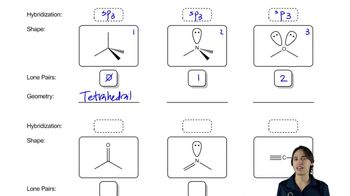
Molecular Geometry Explained.