Ch. 1 - Remembering General Chemistry: Electronic Structure and Bonding (Part 1)
Bruice - Organic Chemistry 8th Edition
Bruice8th EditionOrganic ChemistryISBN: 9780135213711Not the one you use?Change textbook
Chapter 1, Problem 17e

Draw the Lewis structure for each of the following:
e. CH3N+H3

Verified step by step guidance
1
Step 1: Identify the total number of valence electrons in the molecule. Carbon (C) has 4 valence electrons, each hydrogen (H) has 1 valence electron, nitrogen (N) has 5 valence electrons, and the positive charge indicates the loss of one electron. Calculate the total valence electrons: (4 from C) + (3 × 1 from H) + (5 from N) + (3 × 1 from H) - 1 (positive charge).
Step 2: Determine the central atom. Carbon (C) is typically the central atom in organic molecules, as it can form multiple bonds. Place the carbon atom in the center and attach three hydrogen atoms to it.
Step 3: Attach the nitrogen atom to the carbon atom with a single bond. Then, attach three hydrogen atoms to the nitrogen atom. This accounts for the CH3 group bonded to NH3.
Step 4: Distribute the remaining valence electrons around the atoms to satisfy the octet rule for carbon and nitrogen. Hydrogen atoms only need 2 electrons to complete their valence shell, which is already satisfied by their bonds.
Step 5: Ensure the positive charge is represented in the structure. Since the molecule is CH3NH3+, the nitrogen atom will have a formal positive charge due to the loss of one electron. Verify that all atoms have the correct number of electrons and the structure reflects the positive charge.

Verified video answer for a similar problem:

This video solution was recommended by our tutors as helpful for the problem above.
Video duration:
3m
Was this helpful?

Key Concepts

Here are the essential concepts you must grasp in order to answer the question correctly.

Lewis Structures

Lewis structures are diagrams that represent the bonding between atoms in a molecule and the lone pairs of electrons that may exist. They use dots to represent electrons and lines to represent bonds, allowing chemists to visualize the arrangement of atoms and the distribution of electrons. Understanding how to draw Lewis structures is essential for predicting molecular geometry and reactivity.
Recommended video:
Guided course
04:12
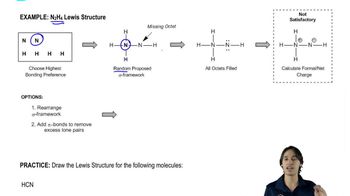
Drawing the Lewis Structure for N2H4.

Formal Charge

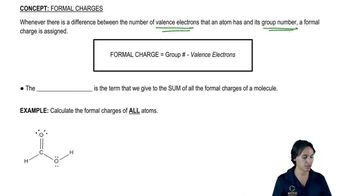
Formal charge is a concept used to determine the distribution of electrons in a molecule. It is calculated by taking the number of valence electrons in an atom, subtracting the number of non-bonding electrons, and half the number of bonding electrons. This helps in assessing the stability of a Lewis structure, as structures with formal charges closest to zero are generally more stable.
Recommended video:
Guided course
01:34
Calculating formal and net charge.

Cation Structure

A cation is a positively charged ion formed when an atom loses one or more electrons. In the case of CH3NH3+, the presence of a positive charge indicates that the molecule has one fewer electron than protons. Understanding how to account for this charge when drawing the Lewis structure is crucial, as it affects the overall electron count and the arrangement of atoms.
Recommended video:
0:52
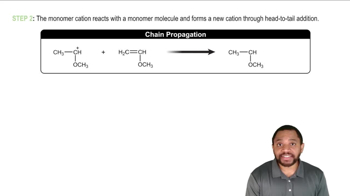
Cationic Polymerization Concept 3