 Back
BackFoundations of Organic Chemistry: Atomic Structure, Bonding, and Molecular Properties
Study Guide - Smart Notes
 Tailored notes based on your materials, expanded with key definitions, examples, and context.
Review of General Chemistry for Organic Chemistry
Atomic Structure and Electron Configuration
Understanding atomic structure is fundamental to organic chemistry, as it determines how atoms bond and interact in molecules.
Atomic Number (Z): The number of protons in the nucleus of an atom, defining the element.
Mass Number (A): The sum of protons and neutrons in the nucleus.
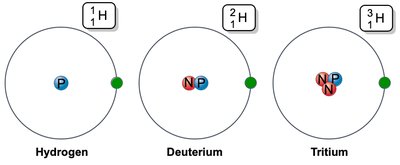
Isotopes: Atoms of the same element with different numbers of neutrons.
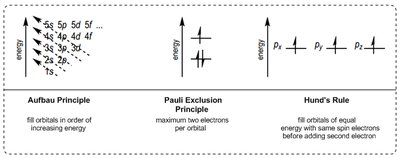
Electron Configuration: The arrangement of electrons in atomic orbitals, following the Aufbau Principle (fill lowest energy orbitals first), Pauli Exclusion Principle (max two electrons per orbital), and Hund's Rule (fill degenerate orbitals singly first).
Orbitals: Regions of space where electrons are likely to be found (s, p, d, f types).
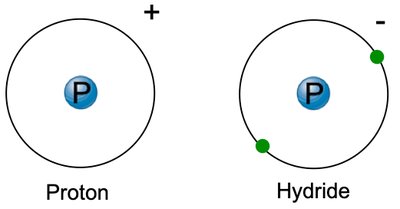
Ions: Atoms with unequal numbers of protons and electrons. Cations are positively charged; anions are negatively charged.
Quantum Mechanics and Atomic Orbitals
Quantum mechanics describes electrons as both particles and waves, leading to the concept of atomic orbitals and electron probability distributions.
Heisenberg Uncertainty Principle: It is impossible to know both the position and momentum of an electron simultaneously.
Wave Functions (ψ): Mathematical descriptions of electron behavior; the square of the wave function (ψ²) gives the probability density.
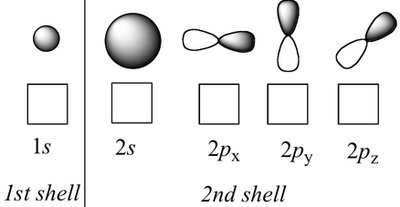
Atomic Orbitals: 3D regions where electrons are likely to be found (e.g., 1s, 2s, 2p).
Molecular Orbital Theory
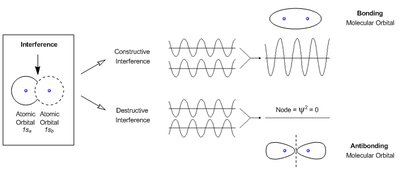
Molecular orbital (MO) theory explains how atomic orbitals combine to form molecular orbitals, which can be bonding or antibonding.
Constructive Interference: Leads to bonding molecular orbitals (increased electron density between nuclei).
Destructive Interference: Leads to antibonding molecular orbitals (node between nuclei).
Sigma (σ) and Pi (π) Bonds
Covalent bonds in organic molecules are classified as sigma or pi bonds based on orbital overlap.
Sigma (σ) Bonds: Formed by head-on overlap of orbitals; all single bonds are sigma bonds.
Pi (π) Bonds: Formed by side-on overlap of p orbitals; present in double and triple bonds.
Single Bond | Double Bond | Triple Bond | |
|---|---|---|---|
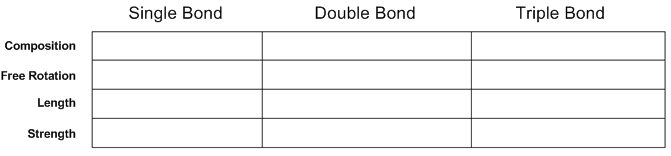
Composition | 1 σ | 1 σ + 1 π | 1 σ + 2 π |
Free Rotation | Yes | No | No |
Length | Longest | Intermediate | Shortest |
Strength | Weakest | Intermediate | Strongest |
Periodic Trends: Electronegativity
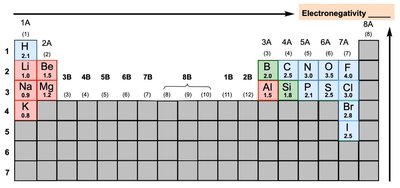
Electronegativity is the tendency of an atom to attract electrons in a chemical bond. It increases across a period and up a group in the periodic table.
Most electronegative element: Fluorine (F).
Periodic trend: Increases left to right, decreases top to bottom.
Octet Rule and Bonding Preferences
Atoms tend to gain, lose, or share electrons to achieve a stable octet configuration, similar to noble gases.
Octet Rule: Most main group elements prefer 8 valence electrons.
Exceptions: Hydrogen (2), Beryllium (4), Boron (6), expanded octets for third-row elements.
Lewis Structures and Formal Charge
Lewis structures represent the arrangement of atoms, bonds, and lone pairs in a molecule. Formal charge helps determine the most stable structure.
Formal Charge Formula:
Best Lewis Structure: Minimizes formal charges and places negative charges on more electronegative atoms.
Resonance Structures
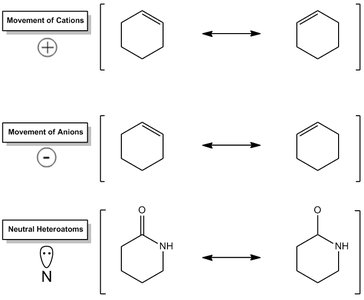
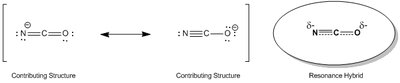
Some molecules are best represented by two or more valid Lewis structures, called resonance structures. The actual molecule is a resonance hybrid of these contributors.
Resonance: Only electrons (not atoms) move between structures.
Resonance Hybrid: The true structure is a weighted average of all contributors.
Hybridization and Molecular Geometry
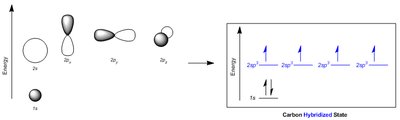
Hybridization describes the mixing of atomic orbitals to form new, equivalent hybrid orbitals for bonding. The geometry of a molecule is determined by the number of electron groups around the central atom (VSEPR theory).
sp3 Hybridization: 4 electron groups, tetrahedral geometry, 109.5° bond angle.
sp2 Hybridization: 3 electron groups, trigonal planar geometry, 120° bond angle.
sp Hybridization: 2 electron groups, linear geometry, 180° bond angle.
Molecular Polarity
Molecular polarity depends on both the polarity of individual bonds and the geometry of the molecule.
Nonpolar Molecules: Symmetrical shape, dipoles cancel out.
Polar Molecules: Asymmetrical shape, net dipole moment.
Functional Groups in Organic Chemistry
Functional groups are specific groups of atoms within molecules that are responsible for characteristic chemical reactions.
Examples: Alkanes, alkenes, alkynes, alcohols, ethers, amines, carbonyls (aldehydes, ketones), carboxylic acids, esters, amides, halides, etc.
Structural Representations
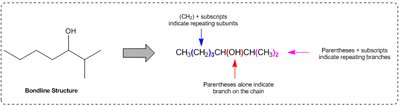
Organic molecules can be represented in several ways: Lewis structures, condensed formulas, and bond-line (skeletal) structures. Each method has its own conventions and uses.
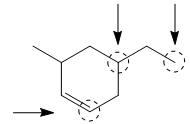
Bond-line structures: Corners and line ends represent carbon atoms; hydrogens on carbons are implied.
Condensed formulas: Show connectivity in a compact form.
Index of Hydrogen Deficiency (IHD)
IHD is a calculation used to determine the degree of unsaturation (rings and multiple bonds) in a molecule from its molecular formula.
Formula: , where C = carbons, N = nitrogens, H = hydrogens, X = halogens.
Interpretation: 1 IHD = 1 ring or 1 double bond; 2 IHD = 2 double bonds, 1 triple bond, or 1 ring + 1 double bond, etc.
Constitutional Isomers
Constitutional isomers are compounds with the same molecular formula but different connectivity of atoms.
Identification: Compare atom count and connectivity; if both match, they are identical; if only atom count matches, they are isomers.
Summary Table: Bonding Preferences of Main Group Elements
Element | Group | Bonding Preference | Bonds | Lone Pairs |
|---|---|---|---|---|
Hydrogen (H) | 1A | 1 bond | 1 | 0 |
Beryllium (Be) | 2A | 2 bonds | 2 | 0 |
Boron (B) | 3A | 3 bonds | 3 | 0 |
Carbon (C) | 4A | 4 bonds | 4 | 0 |
Nitrogen (N) | 5A | 3 bonds | 3 | 1 |
Oxygen (O) | 6A | 2 bonds | 2 | 2 |
Fluorine (F) | 7A | 1 bond | 1 | 3 |
Applications and Examples
Organic Molecules in Life: Organic chemistry is the chemistry of carbon compounds, essential for biological systems.
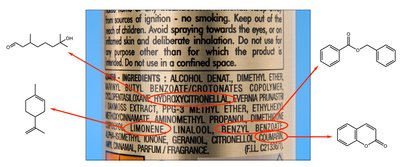
Functional Groups in Products: Many everyday products (e.g., hairspray) contain organic molecules with various functional groups.
 *Additional info: This guide covers foundational concepts from atomic structure and bonding to resonance, hybridization, and functional groups, providing a strong basis for further study in organic chemistry.*
