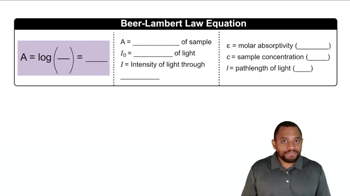
It describes a linear relationship between the concentration of a sample and its light absorbance.
What variable is used to represent concentration in the Beer-Lambert law?
The variable 'c' is used to represent concentration.
What is the symbol for absorbance in the Beer-Lambert law?
Absorbance is represented by the capital letter 'A'.
What does molar absorptivity represent and what is its symbol?
Molar absorptivity measures how strongly a substance absorbs light and is symbolized by epsilon (ε).
How does the intensity of light change as it passes through a sample?
The intensity decreases, so I is smaller than I₀ after passing through the sample.
What is the equation for the Beer-Lambert law?
A = log(I₀/I) = ε * c * l, where A is absorbance, I₀ is initial intensity, I is final intensity, ε is molar absorptivity, c is concentration, and l is path length.
What are the units for molar absorptivity (ε)?
The units are liters per mole per centimeter (L·mol⁻¹·cm⁻¹).
What does the path length (l) represent in the Beer-Lambert law?
Path length (l) is the distance the light travels through the sample, measured in centimeters.
How does concentration affect the intensity of light (I) after passing through a solution?
Higher concentration causes more light to be absorbed, making I smaller compared to I₀.
What is the relationship between absorbance and concentration according to the Beer-Lambert law?
Absorbance increases linearly with concentration.
What is lambda max in the context of Beer-Lambert law graphs?
Lambda max is the wavelength at which the absorbance is at its peak on the graph.
How is absorbance measured in a laboratory setup?
Absorbance is measured by comparing the intensity of light before (I₀) and after (I) it passes through the sample using a detector.
What happens to absorbance if the solution is diluted?
A diluted solution absorbs less light, resulting in a higher I and lower absorbance.
What is the significance of the log(I₀/I) term in the Beer-Lambert law equation?
It quantifies how much light is absorbed by the sample compared to the initial intensity.
Why is path length measured in centimeters in the Beer-Lambert law?
Because molar absorptivity's units include centimeters inverse, so path length must be in centimeters for consistency.
 Back
Back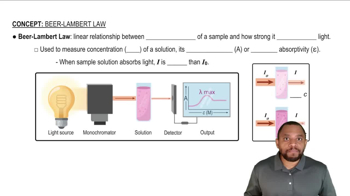
 2:36
2:36