Back

The 18 and 16 Electron Rule quiz

Control buttons has been changed to "navigation" mode.
1/15
  • What rule do main group elements typically follow to achieve stability?

    Main group elements typically follow the octet rule, aiming for 8 electrons to achieve a noble gas configuration.
  • Which elements are exceptions to the octet rule among main group elements?

    Hydrogen and helium are exceptions to the octet rule.
  • What rule is used to indicate the stability of transition metal complexes?

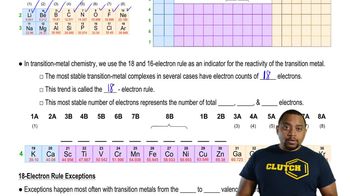
    The 18 electron rule is used to indicate the stability of transition metal complexes.
  • How is the number 18 derived in the 18 electron rule?

    It is the sum of the maximum electrons that s (2), p (6), and d (10) orbitals can hold, totaling 18.
  • What is the most stable electron count for many transition metal complexes?

    The most stable electron count for many transition metal complexes is 18 electrons.
  • Which transition metals commonly follow the 16 electron rule in catalyzed reactions?

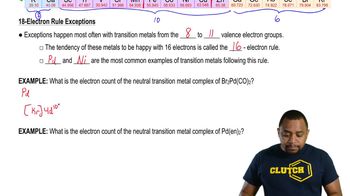
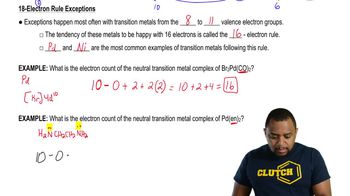
    Palladium and nickel commonly follow the 16 electron rule in catalyzed reactions.
  • What is the 16 electron rule?

    The 16 electron rule refers to the tendency of some transition metals to be stable with only 16 valence electrons.
  • For which groups of transition metals are exceptions to the 18 electron rule most common?

    Exceptions are most common for transition metals with 8 to 11 valence electrons.
  • Why do transition metals ideally want 18 electrons?

    Transition metals ideally want 18 electrons to achieve a noble gas-like configuration and maximum stability.
  • What is the ideal electron count for main group elements and why?

    The ideal electron count is 8, because this fills their s and p orbitals, achieving a noble gas configuration.
  • Which orbitals are considered when counting electrons for the 18 electron rule?

    The s, p, and d orbitals are considered when counting electrons for the 18 electron rule.
  • How many electrons can the s, p, and d orbitals each hold?

    The s orbital holds 2, the p orbital holds 6, and the d orbital holds 10 electrons.
  • What is the main difference between the octet rule and the 18 electron rule?

    The octet rule applies to main group elements aiming for 8 electrons, while the 18 electron rule applies to transition metals aiming for 18 electrons.
  • Why are palladium and nickel important in organic chemistry catalysis regarding electron count?

    They are important because they are often stable with 16 electrons, which is common in catalyzed reactions.
  • What is the general trend for electron count and stability in transition metals?

    Transition metals are most stable with 18 electrons, but some can be stable with 16 electrons, especially in certain groups or reactions.