Back

The 18 and 16 Electron Rule definitions

Control buttons has been changed to "navigation" mode.
1/13
  • Octet Rule

    Guideline where main group elements seek 8 valence electrons to mimic noble gas stability.
  • Transition Metal

    Element found in groups 3 to 12, often forming complexes with variable electron counts.
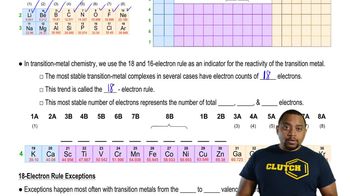
  • 18 Electron Rule

    Stability principle where transition metal complexes are most stable with 18 valence electrons.
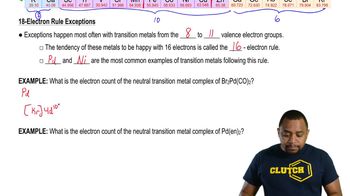
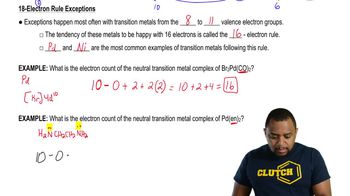
  • 16 Electron Rule

    Guideline where certain transition metal complexes, especially with palladium or nickel, are stable with 16 electrons.
  • Valence Electron

    Electron in the outermost shell, crucial for bonding and determining chemical reactivity.
  • Noble Gas Configuration

    Electron arrangement resembling that of noble gases, associated with maximum stability.
  • s Orbital

    Spherical atomic orbital capable of holding up to 2 electrons, contributing to electron count.
  • p Orbital

    Dumbbell-shaped atomic orbital, each set holding up to 6 electrons, important in electron counting.
  • d Orbital

    Set of five orbitals in transition metals, collectively holding up to 10 electrons.
  • Electron Count

    Total number of electrons assigned to a metal complex, used to predict stability.
  • Main Group Element

    Element in groups 1A to 8A, typically following the octet rule for stability.
  • Palladium

    Transition metal frequently forming stable complexes with 16 valence electrons in catalysis.
  • Nickel

    Transition metal known for stable 16-electron complexes, especially in organic reactions.