Back

Tautomers of Dicarbonyl Compounds quiz

Control buttons has been changed to "navigation" mode.
1/15
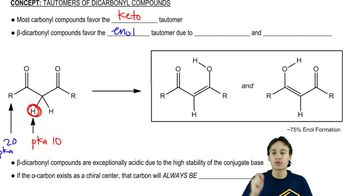
  • What is a beta-dicarbonyl compound?

    A beta-dicarbonyl compound has two carbonyl groups separated by one carbon (the beta position).
  • Why do most carbonyl compounds favor the keto tautomer over the enol form?

    The keto tautomer is more thermodynamically stable than the enol form due to its lower energy.
  • Why do beta-dicarbonyl compounds favor the enol tautomer?

    Beta-dicarbonyl compounds favor the enol tautomer because conjugation and hydrogen bonding stabilize the enol form.
  • What is the typical pKa range for the methylene hydrogen in beta-dicarbonyl compounds?

    The pKa of the methylene hydrogen in beta-dicarbonyl compounds is around 9-11, making it highly acidic.
  • How does the acidity of beta-dicarbonyl compounds compare to ammonium (NH4+)?

    The acidity is similar, as both have pKa values in the 9-11 range.
  • What structural feature stabilizes the enol form in beta-dicarbonyl compounds?

    Overlapping resonance (conjugation) and hydrogen bonding stabilize the enol form.
  • What percentage of enol content can be found at equilibrium in beta-dicarbonyl compounds?

    Up to 75% enol content can be present at equilibrium, depending on the substituent groups.
  • How does the nature of R groups affect enol content in beta-dicarbonyl compounds?

    Different R groups can change the equilibrium percentage of enol content.
  • What happens to a chiral center at the alpha carbon during tautomerization in beta-dicarbonyl compounds?

    The chiral center will racemize, resulting in a 50/50 mixture of enantiomers.
  • Why does racemization occur at the alpha carbon in beta-dicarbonyl compounds?

    Racemization occurs because forming the enol intermediate causes loss of stereochemistry.
  • What is the effect of tautomerization on the stereochemistry of beta-dicarbonyl compounds?

    Tautomerization leads to loss of stereochemistry and racemization at the alpha carbon.
  • Why are beta-dicarbonyl compounds important in organic synthesis?

    They are important because they undergo efficient tautomerization, enabling various reactions.
  • What stabilizes the conjugate base of beta-dicarbonyl compounds?

    The conjugate base is stabilized by resonance and hydrogen bonding.
  • What happens to the geometry of the alpha carbon during enol formation?

    The alpha carbon becomes trigonal planar, losing its original stereochemistry.
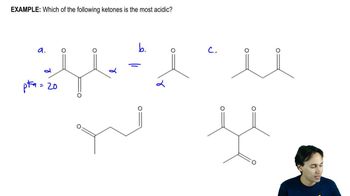
  • How can you determine which beta-dicarbonyl compound is most acidic?

    The most acidic compound is the one that can form the most stabilized tautomers.