Back

Tautomers of Dicarbonyl Compounds definitions

Control buttons has been changed to "navigation" mode.
1/13
  • Beta-dicarbonyl Compound

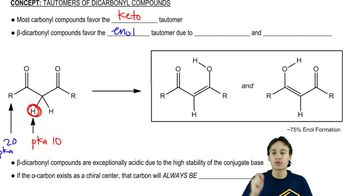
    A molecule with two carbonyl groups separated by one carbon, leading to unique acidity and tautomerization properties.
  • Enol Tautomer

    A structural form featuring a hydroxyl group bonded to a carbon-carbon double bond, stabilized by resonance and hydrogen bonding.
  • Keto Tautomer

    A structural form with a carbonyl group, generally more stable than its enol counterpart except in certain dicarbonyl systems.
  • Conjugation

    A stabilizing effect from overlapping p orbitals, allowing electron delocalization across adjacent atoms in a molecule.
  • Hydrogen Bonding

    An interaction where a hydrogen atom forms a bridge between electronegative atoms, enhancing molecular stability.
  • Methylene Carbon

    The central carbon atom between two carbonyl groups in a beta-dicarbonyl, notable for its high acidity.
  • pKa

    A numerical value indicating the acidity of a hydrogen atom in a molecule; lower values mean higher acidity.
  • Conjugate Base

    The species formed after a molecule donates a proton, often stabilized in beta-dicarbonyl systems.
  • Racemization

    A process where a chiral center loses its stereochemistry, resulting in an equal mixture of enantiomers.
  • Alpha Carbon

    The carbon atom directly adjacent to a carbonyl group, often involved in tautomerization and racemization.
  • Enantiomer

    One of two non-superimposable mirror-image forms of a chiral molecule, produced in equal amounts during racemization.
  • Tautomerization

    A chemical equilibrium process where a molecule interconverts between two structural isomers, such as keto and enol forms.
  • Organic Synthesis

    A field of chemistry focused on constructing complex molecules, often utilizing the reactivity of beta-dicarbonyl compounds.