Organic Chemistry
My Course
Learn
Exam Prep
AI Tutor
Study Guides
Textbook Solutions
Flashcards
Explore
Try the app
My Course
Learn
Exam Prep
AI Tutor
Study Guides
Textbook Solutions
Flashcards
Explore
Try the app
Back
Synthesis of Amino Acids: Acetamidomalonic Ester Synthesis quiz
You can tap to flip the card.
What is the acetamidomalonic ester synthesis a variation of?
You can tap to flip the card.
👆
What is the acetamidomalonic ester synthesis a variation of?
It is a variation of the malonic ester synthesis.
Track progress
Control buttons has been changed to "navigation" mode.
1/15
Related flashcards
Related practice
Recommended videos
Synthesis of Amino Acids: Acetamidomalonic Ester Synthesis definitions
Synthesis of Amino Acids: Acetamidomalonic Ester Synthesis
13 Terms
26. Amino Acids, Peptides, and Proteins
5 topics
13 problems
Chapter
Johnny
2:20
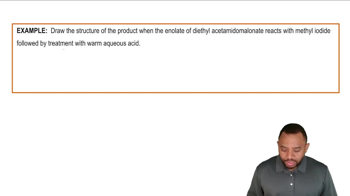
Synthesis of Amino Acids: Acetamidomalonic Ester Synthesis Example 1
3:33
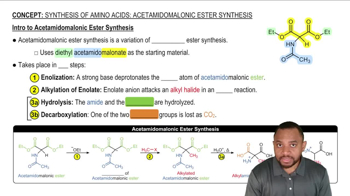
Synthesis of Amino Acids: Acetamidomalonic Ester Synthesis Concept 1
1
views
01:28
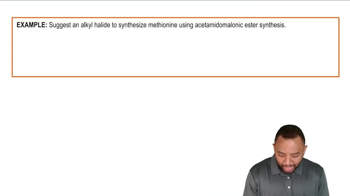
Synthesis of Amino Acids: Acetamidomalonic Ester Synthesis Example 2
Terms in this set (15)
Hide definitions
What is the acetamidomalonic ester synthesis a variation of?
It is a variation of the malonic ester synthesis.
What are the three main steps in the acetamidomalonic ester synthesis?
The three main steps are enolization, alkylation, and hydrolysis followed by decarboxylation.
What happens during the enolization step of acetamidomalonic ester synthesis?
A strong base deprotonates the alpha carbon of the acetamidomalonic ester, forming an enolate.
Which base is commonly used to deprotonate the alpha carbon in this synthesis?
Ethoxide is commonly used as the strong base.
What type of reaction occurs when the enolate attacks an alkyl halide?
An SN2 reaction occurs, introducing an alkyl group to the alpha carbon.
What is the purpose of the alkylation step in this synthesis?
The alkylation step attaches an alkyl group to the alpha carbon of the ester.
What functional groups are hydrolyzed in step 3a of the synthesis?
Both the esters and the amide groups are hydrolyzed.
What does hydrolysis convert esters and amides into during this synthesis?
Hydrolysis converts esters and amides into carboxylic acids and a protonated amino group.
What occurs during the decarboxylation step (step 3b)?
One carboxylic acid group is lost as carbon dioxide upon heating.
What is the final product of the acetamidomalonic ester synthesis?
The final product is an amino acid.
Which part of the amino acid structure comes from the acetamidomalonic ester?
The carboxylic acid, the protonated amino group, and the alpha carbon come from the acetamidomalonic ester.
Where does the side chain (R group) of the amino acid originate in this synthesis?
The side chain comes from the alkyl halide used in the alkylation step.
Why is retrosynthetic analysis useful in acetamidomalonic ester synthesis?
It helps trace the origins of the amino acid components back to the starting materials.
What is lost as a gas during the decarboxylation step?
Carbon dioxide (CO2) is lost as a gas.
How does the acetamidomalonic ester synthesis help in designing synthetic pathways for amino acids?
By working backwards from the product to the starting materials, it helps identify the necessary reagents and steps.