Organic Chemistry
My Course
Learn
Exam Prep
AI Tutor
Study Guides
Textbook Solutions
Flashcards
Explore
Try the app
My Course
Learn
Exam Prep
AI Tutor
Study Guides
Textbook Solutions
Flashcards
Explore
Try the app
Back
Synthesis of Amino Acids: Acetamidomalonic Ester Synthesis definitions
You can tap to flip the card.
Acetamidomalonic Ester
You can tap to flip the card.
👆
Acetamidomalonic Ester
A compound featuring both amide and ester groups, serving as the starting material for synthesizing amino acids via a three-step process.
Track progress
Control buttons has been changed to "navigation" mode.
1/13
Related flashcards
Related practice
Recommended videos
Synthesis of Amino Acids: Acetamidomalonic Ester Synthesis quiz
Synthesis of Amino Acids: Acetamidomalonic Ester Synthesis
15 Terms
26. Amino Acids, Peptides, and Proteins
5 topics
13 problems
Chapter
Johnny
2:20
Synthesis of Amino Acids: Acetamidomalonic Ester Synthesis Example 1
3:33
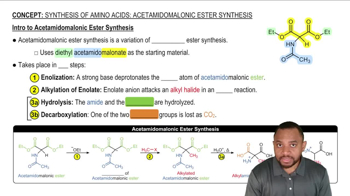
Synthesis of Amino Acids: Acetamidomalonic Ester Synthesis Concept 1
1
views
01:28
Synthesis of Amino Acids: Acetamidomalonic Ester Synthesis Example 2
Terms in this set (13)
Hide definitions
Acetamidomalonic Ester
A compound featuring both amide and ester groups, serving as the starting material for synthesizing amino acids via a three-step process.
Malonic Ester Synthesis
A classic method for constructing substituted acetic acids, adapted here to introduce amino groups for amino acid formation.
Enolization
A process where a strong base removes an alpha hydrogen, generating a resonance-stabilized enolate intermediate.
Enolate
A negatively charged intermediate formed after deprotonation at the alpha carbon, crucial for nucleophilic attack.
Alpha Carbon
The central carbon atom situated between two carbonyl groups, serving as the site for deprotonation and alkylation.
Ethoxide
A strong base commonly used to deprotonate the alpha carbon, initiating enolate formation.
Alkyl Halide
An organic molecule containing a halogen, used to introduce an alkyl group to the enolate via SN2 reaction.
SN2 Reaction
A bimolecular nucleophilic substitution where the enolate attacks the alkyl halide, displacing the halogen.
Hydrolysis
A reaction converting esters and amides into carboxylic acids and protonated amino groups using water.
Decarboxylation
A thermal process where a carboxylic acid group is removed as carbon dioxide, finalizing amino acid formation.
Carboxylic Acid
A functional group produced after hydrolysis, present in the final amino acid structure.
Protonated Amino Group
A positively charged nitrogen-containing group formed after amide hydrolysis, essential in amino acids.
Retrosynthetic Analysis
A strategy for tracing the origins of product fragments back to starting materials to plan synthetic routes.