Back

Stability of Conjugated Intermediates quiz

Control buttons has been changed to "navigation" mode.
1/15
  • How does conjugation affect the stability of organic reaction intermediates?

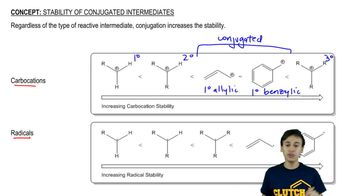
    Conjugation stabilizes intermediates by allowing resonance, which delocalizes charge or unpaired electrons, making the intermediate more stable.
  • Which is more stable: a primary allylic carbocation or a typical primary carbocation, and why?

    A primary allylic carbocation is more stable because it can resonate, whereas a typical primary carbocation cannot.
  • What is the trend in carbocation stability as you add more alkyl (R) groups?

    Carbocation stability increases as you add more alkyl groups, with tertiary being the most stable due to hyperconjugation.
  • Why are primary benzylic carbocations more stable than typical primary carbocations?

    Primary benzylic carbocations are more stable because the positive charge can be delocalized into the aromatic ring through resonance.
  • How does resonance affect radicals compared to carbocations?

    Resonance stabilizes radicals even more than carbocations, making allylic and benzylic radicals especially stable.
  • What is the most stable type of radical, and why?

    Allylic and benzylic radicals are the most stable because resonance allows the unpaired electron to be delocalized.
  • What is the effect of conjugation at the allylic position on reactivity?

    Conjugation at the allylic position increases stability, making it a preferred site for reactions involving radicals or carbocations.
  • What happens during the termination step of a radical reaction at the allylic position?

    Two radicals combine to form a new sigma bond, resulting in a stable product.
  • How can a nucleophile react with a carbocation at the allylic position?

    A nucleophile can attack the carbocation, forming a new bond at the allylic position while the double bond remains.
  • Why do reactions often occur at the allylic position in conjugated systems?

    The allylic position is highly reactive due to the extra stability provided by resonance, making it a common site for intermediate formation.
  • What is the difference in stabilization between hyperconjugation and resonance for carbocations?

    Hyperconjugation from alkyl groups is the main stabilizing factor for carbocations, but resonance can make even primary carbocations more stable if conjugated.
  • What is meant by a 'conjugated primary carbocation'?

    A conjugated primary carbocation is a primary carbocation that can resonate, such as primary allylic or benzylic carbocations.
  • How does the stability of radicals change as you add alkyl groups?

    Radical stability increases with more alkyl groups, but resonance provides even greater stabilization than alkyl substitution.
  • What is a common feature of both allylic and benzylic intermediates?

    Both can stabilize charges or unpaired electrons through resonance with adjacent double bonds or aromatic rings.
  • What is the outcome when a reactive intermediate forms at the allylic position and reacts with another reagent?

    A new atom or group attaches at the allylic position, and the double bond is typically retained in the product.