Organic Chemistry
My Course
Learn
Exam Prep
AI Tutor
Study Guides
Textbook Solutions
Flashcards
Explore
Try the app
My Course
Learn
Exam Prep
AI Tutor
Study Guides
Textbook Solutions
Flashcards
Explore
Try the app
Back
Stability of Conjugated Intermediates definitions
You can tap to flip the card.
Conjugation
You can tap to flip the card.
👆
Conjugation
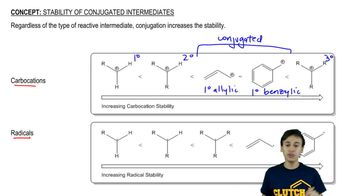
Delocalization of electrons across adjacent p orbitals, increasing stability of intermediates through resonance.
Track progress
Control buttons has been changed to "navigation" mode.
1/13
Related flashcards
Related practice
Recommended videos
Stability of Conjugated Intermediates quiz
Stability of Conjugated Intermediates
15 Terms
Stability of Conjugated Intermediates
16. Conjugated Systems
5 problems
Topic

Laura
16. Conjugated Systems - Part 1 of 3
4 topics
15 problems
Chapter
Johnny
16. Conjugated Systems - Part 2 of 3
6 topics
14 problems
Chapter
Johnny
16. Conjugated Systems - Part 3 of 3
6 topics
14 problems
Chapter
Johnny
Guided course
04:31
Stability of Conjugated Intermediates
3
views
Terms in this set (13)
Hide definitions
Conjugation
Delocalization of electrons across adjacent p orbitals, increasing stability of intermediates through resonance.
Resonance
Electron delocalization that distributes charge over multiple atoms, reducing energy and increasing stability.
Carbocation
Positively charged carbon species whose stability increases with more alkyl groups and resonance.
Radical
Neutral species with an unpaired electron, highly stabilized at allylic and benzylic positions by resonance.
Allylic Position
Location adjacent to a double bond, ideal for stabilizing intermediates via resonance.
Benzylic Position
Site directly attached to a benzene ring, offering exceptional resonance stabilization for intermediates.
Hyperconjugation
Stabilization effect from adjacent sigma bonds, especially important for carbocation stability.
Primary Carbocation
Species with a positive charge on a carbon attached to one other carbon, generally unstable unless conjugated.
Tertiary Carbocation
Species with a positive charge on a carbon attached to three other carbons, highly stabilized by hyperconjugation.
Termination Step
Final stage in radical reactions where two radicals combine to form a stable sigma bond.
Nucleophilic Attack
Process where an electron-rich species donates a pair of electrons to an electron-deficient intermediate.
Sigma Bond
Strong covalent bond formed by direct overlap of orbitals, often resulting from radical combination.
Reactive Intermediate
Short-lived, high-energy species such as carbocations or radicals, crucial in organic reaction mechanisms.