Skip to main content
Organic Chemistry
My Course
Learn
Exam Prep
AI Tutor
Study Guides
Textbook Solutions
Flashcards
Explore
Try the app
My Course
Learn
Exam Prep
AI Tutor
Study Guides
Textbook Solutions
Flashcards
Explore
Try the app
Back
SNAr Reactions of Pyridine quiz
You can tap to flip the card.
What does SNAr stand for in organic chemistry?
You can tap to flip the card.
👆
What does SNAr stand for in organic chemistry?
SNAr stands for nucleophilic aromatic substitution.
Track progress
Control buttons has been changed to "navigation" mode.
1/15
Related flashcards
Related practice
Recommended videos
SNAr Reactions of Pyridine definitions
SNAr Reactions of Pyridine
14 Terms
SNAr Reactions of Pyridine
27. Heterocycles
5 problems
Topic
Side-Chain Reactions of Substituted Pyridines
27. Heterocycles
5 problems
Topic
27. Heterocycles - Part 1 of 2
4 topics
12 problems
Chapter
27. Heterocycles - Part 2 of 2
4 topics
12 problems
Chapter
Guided course
1:07
SNAr Reactions of Pyridine Concept 2
5
views
Guided course
1:04
SNAr Reactions of Pyridine Example 2
4
views
Guided course
3:57
SNAr Reactions of Pyridine Example 1
5
views
Terms in this set (15)
Hide definitions
What does SNAr stand for in organic chemistry?
SNAr stands for nucleophilic aromatic substitution.
Why is pyridine more susceptible to SNAr reactions than benzene?
Pyridine is more electron-deficient than benzene, making it more reactive toward nucleophilic aromatic substitution.
At which position on the pyridine ring do SNAr reactions typically occur?
SNAr reactions of pyridine typically occur at the ortho position.
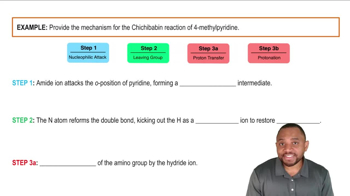
What is the Chichibabin reaction used to synthesize?
The Chichibabin reaction is used to synthesize 2-aminopyridine.
Which reagent is used in the Chichibabin reaction with pyridine?
Sodium amide (NaNH2) is used in the Chichibabin reaction with pyridine.
What is the mechanism type for nucleophilic aromatic substitution reactions?
Nucleophilic aromatic substitution occurs via an addition-elimination mechanism.
What is the byproduct formed in the Chichibabin reaction?
The byproduct formed is hydrogen gas (H2).
What role does sodium amide play in the Chichibabin reaction?
Sodium amide acts as a strong base to facilitate the substitution of hydrogen with an amino group.
What is the final product of the Chichibabin reaction on pyridine?
The final product is 2-aminopyridine.
Which organometallic reagents are used for ortho-alkylation of pyridine?
Grignard reagents and organolithium compounds are used for ortho-alkylation of pyridine.
What is replaced on the pyridine ring during organometallic SNAr reactions?
A hydrogen atom is replaced with an alkyl or carbon group during organometallic SNAr reactions.
What is the solvent commonly used in the Chichibabin reaction?
Ammonia is commonly used as the solvent in the Chichibabin reaction.
How does the reactivity of pyridine compare to benzene in SNAr reactions?
Pyridine is more reactive than benzene in SNAr reactions due to its electron-deficient nature.
What is the purpose of acidic hydrolysis after the Chichibabin reaction?
Acidic hydrolysis is used to complete the reaction and isolate the 2-aminopyridine product.
What types of carbon groups can be introduced to pyridine via organometallic SNAr reactions?
Methyl, ethyl, longer alkyl chains, rings, or benzene groups can be introduced via organometallic SNAr reactions.
 BackBack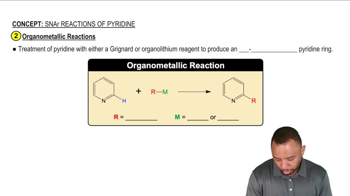
 1:07
1:07