Skip to main content
Organic Chemistry
My Course
Learn
Exam Prep
AI Tutor
Study Guides
Textbook Solutions
Flashcards
Explore
Try the app
My Course
Learn
Exam Prep
AI Tutor
Study Guides
Textbook Solutions
Flashcards
Explore
Try the app
Back
SNAr Reactions of Pyridine definitions
You can tap to flip the card.
Pyridine
You can tap to flip the card.
👆
Pyridine
A six-membered aromatic heterocycle with a nitrogen atom, notable for its electron-deficient ring favoring nucleophilic substitution.
Track progress
Control buttons has been changed to "navigation" mode.
1/14
Related flashcards
Related practice
Recommended videos
SNAr Reactions of Pyridine quiz
SNAr Reactions of Pyridine
15 Terms
SNAr Reactions of Pyridine
27. Heterocycles
5 problems
Topic
Side-Chain Reactions of Substituted Pyridines
27. Heterocycles
5 problems
Topic
27. Heterocycles - Part 1 of 2
4 topics
12 problems
Chapter
27. Heterocycles - Part 2 of 2
4 topics
12 problems
Chapter
Guided course
1:07
SNAr Reactions of Pyridine Concept 2
5
views
Guided course
1:04
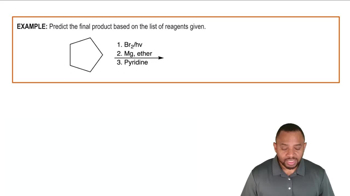
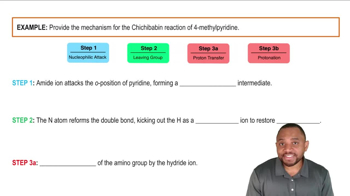
SNAr Reactions of Pyridine Example 2
4
views
Guided course
3:57
SNAr Reactions of Pyridine Example 1
5
views
Terms in this set (14)
Hide definitions
Pyridine
A six-membered aromatic heterocycle with a nitrogen atom, notable for its electron-deficient ring favoring nucleophilic substitution.
Nucleophilic Aromatic Substitution
A reaction where a nucleophile replaces a leaving group on an aromatic ring, often via addition-elimination, especially in electron-poor rings.
Ortho Position
The site adjacent to the nitrogen atom on pyridine, commonly targeted in substitution reactions due to increased reactivity.
Chichibabin Reaction
A process using sodium amide to introduce an amino group at the ortho position of pyridine, yielding 2-aminopyridine.
Sodium Amide
A strong base used to deprotonate pyridine, enabling nucleophilic substitution in the Chichibabin reaction.
2-Aminopyridine
A product formed by replacing an ortho hydrogen of pyridine with an amino group, important in pharmaceuticals.
Organometallic Reagent
A compound containing a metal-carbon bond, such as Grignard or organolithium, used to introduce alkyl groups into pyridine.
Grignard Reagent
A magnesium-containing organometallic compound that acts as a nucleophile in aromatic substitution reactions.
Organolithium Reagent
A lithium-based organometallic compound capable of transferring alkyl groups to aromatic rings like pyridine.
Addition-Elimination Mechanism
A two-step process where a nucleophile adds to an aromatic ring, followed by loss of a leaving group to restore aromaticity.
Aromaticity
A property of cyclic, planar molecules with delocalized electrons, conferring extra stability and influencing reactivity.
Nucleophilicity
A measure of a species' tendency to donate electrons and form new bonds with electron-deficient centers.
Alkylation
The introduction of an alkyl group onto a molecule, such as the ortho position of pyridine, often using organometallic reagents.
Acidic Hydrolysis
A step involving acid and water to complete the transformation of intermediates into final products in substitution reactions.
 BackBack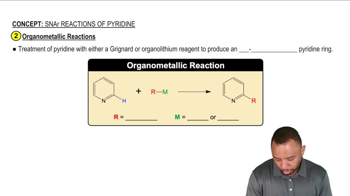
 1:07
1:07