Skip to main content
Organic Chemistry
My Course
Learn
Exam Prep
AI Tutor
Study Guides
Textbook Solutions
Flashcards
Explore
Try the app
My Course
Learn
Exam Prep
AI Tutor
Study Guides
Textbook Solutions
Flashcards
Explore
Try the app
Back
Side-Chain Reactions of Substituted Pyridines quiz
You can tap to flip the card.
Why are benzylic hydrogens in pyridine more acidic than those in benzene?
You can tap to flip the card.
👆
Why are benzylic hydrogens in pyridine more acidic than those in benzene?
Benzylic hydrogens in pyridine are more acidic due to resonance stabilization and the inductive effect of the electronegative nitrogen atom.
Track progress
Control buttons has been changed to "navigation" mode.
1/15
Related flashcards
Related practice
Recommended videos
Side-Chain Reactions of Substituted Pyridines definitions
Side-Chain Reactions of Substituted Pyridines
15 Terms
Side-Chain Reactions of Substituted Pyridines
27. Heterocycles
5 problems
Topic
SNAr Reactions of Pyridine
27. Heterocycles
5 problems
Topic
27. Heterocycles - Part 1 of 2
4 topics
12 problems
Chapter
27. Heterocycles - Part 2 of 2
4 topics
12 problems
Chapter
Guided course
2:36
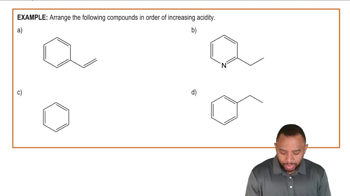
Side-Chain Reactions of Substituted Pyridines Concept 1
6
views
Guided course
1:32
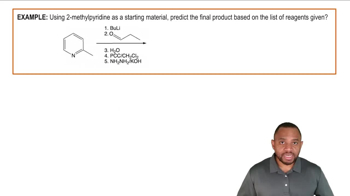
Side-Chain Reactions of Substituted Pyridines Example 1
3
views
Guided course
1:57
Side-Chain Reactions of Substituted Pyridines Example 3
4
views
Terms in this set (15)
Hide definitions
Why are benzylic hydrogens in pyridine more acidic than those in benzene?
Benzylic hydrogens in pyridine are more acidic due to resonance stabilization and the inductive effect of the electronegative nitrogen atom.
What is the typical pKa value for an ordinary benzylic carbanion?
The typical pKa value for an ordinary benzylic carbanion is around 41.
How do the pKa values of alkylated pyridines at C2 and C4 compare to C3?
C2 and C4 alkylated pyridines have lower pKa values (~34) and are more acidic than C3 (~36).
What effect does deprotonation at the benzylic position of pyridine have?
Deprotonation at the benzylic position forms a carbanion stabilized by resonance and the electronegative nitrogen atom.
Why are C2 and C4 positions of alkylated pyridines more acidic?
C2 and C4 positions are more acidic because resonance allows the negative charge to localize on the nitrogen atom.
What is the role of nitrogen in stabilizing the carbanion in pyridine?
Nitrogen stabilizes the carbanion by holding the negative charge due to its higher electronegativity.
Which strong bases can deprotonate the benzylic position in pyridine?
Organolithium compounds and sodium amide are strong bases that can deprotonate the benzylic position.
What happens to the negative charge during resonance in C3 alkylated pyridines?
In C3 alkylated pyridines, the negative charge does not localize on the nitrogen atom during resonance.
How does the conjugate base of pyridine behave in addition reactions?
The conjugate base of pyridine reacts similarly to enolate anions in carbonyl chemistry, forming alpha-beta unsaturated products.
What is the product of an aldol reaction involving enolate anions?
The product is a beta-hydroxy carbonyl compound, which can further dehydrate to form an alpha-beta unsaturated product.
How does the stability of alpha-beta unsaturated products compare in pyridine versus benzene?
Alpha-beta unsaturated products are even more stable in pyridine due to greater conjugation.
What is the significance of resonance structures in pyridine side-chain reactions?
Resonance structures allow the negative charge to be stabilized, especially when it can be placed on the nitrogen atom.
Why is a lower pKa value significant in alkylated pyridines?
A lower pKa value indicates greater acidity, making deprotonation easier at those positions.
What is the main difference in resonance stabilization between C2/C4 and C3 alkylated pyridines?
C2 and C4 allow the negative charge to reside on nitrogen, while C3 does not.
What type of reaction can the deprotonated benzylic carbon in pyridine undergo with aldehydes or ketones?
It can undergo nucleophilic addition, leading to the formation of alpha-beta unsaturated products after dehydration.
 BackBack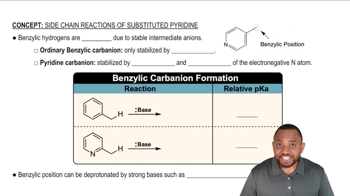
 2:36
2:36