Skip to main content
Organic Chemistry
My Course
Learn
Exam Prep
AI Tutor
Study Guides
Textbook Solutions
Flashcards
Explore
Try the app
My Course
Learn
Exam Prep
AI Tutor
Study Guides
Textbook Solutions
Flashcards
Explore
Try the app
Back
Side-Chain Reactions of Substituted Pyridines definitions
You can tap to flip the card.
Pyridine
You can tap to flip the card.
👆
Pyridine
A six-membered aromatic ring containing one nitrogen atom, which increases electron density and affects acidity and reactivity.
Track progress
Control buttons has been changed to "navigation" mode.
1/15
Related flashcards
Related practice
Recommended videos
Side-Chain Reactions of Substituted Pyridines quiz
Side-Chain Reactions of Substituted Pyridines
15 Terms
Side-Chain Reactions of Substituted Pyridines
27. Heterocycles
5 problems
Topic
SNAr Reactions of Pyridine
27. Heterocycles
5 problems
Topic
27. Heterocycles - Part 1 of 2
4 topics
12 problems
Chapter
27. Heterocycles - Part 2 of 2
4 topics
12 problems
Chapter
2:36
Side-Chain Reactions of Substituted Pyridines Concept 1
2
views
1:32
Side-Chain Reactions of Substituted Pyridines Example 1
2
views
1:57
Side-Chain Reactions of Substituted Pyridines Example 3
1
views
Terms in this set (15)
Hide definitions
Pyridine
A six-membered aromatic ring containing one nitrogen atom, which increases electron density and affects acidity and reactivity.
Benzylic Position
The carbon directly attached to an aromatic ring, notable for its increased acidity and ability to stabilize negative charge.
Carbanion
A negatively charged carbon species, whose stability is enhanced by resonance and electronegative atoms nearby.
Resonance Structure
Alternative electron arrangements in a molecule that delocalize charge, increasing stability of intermediates.
Inductive Effect
Electron withdrawal or donation through sigma bonds, often by electronegative atoms, influencing acidity and charge distribution.
pKa
A numerical value indicating the acidity of a hydrogen atom in a molecule; lower values correspond to higher acidity.
Organolithium
A strong base containing lithium bonded to carbon, commonly used to deprotonate acidic hydrogens in organic synthesis.
Sodium Amide
A powerful inorganic base (NaNH2) used to remove protons from especially acidic positions in aromatic compounds.
Conjugate Base
The species formed after a molecule loses a proton, often more nucleophilic and reactive in subsequent steps.
Enolate Anion
A resonance-stabilized anion formed by deprotonation next to a carbonyl, capable of nucleophilic addition.
Aldol Reaction
A process where an enolate attacks a carbonyl compound, forming a beta-hydroxy carbonyl intermediate.
Alpha-Beta Unsaturated Product
A compound with a double bond between the alpha and beta carbons relative to a functional group, increasing conjugation and stability.
Deprotonation
The removal of a proton (H+) from a molecule, often generating a reactive anion.
Electronegativity
The tendency of an atom to attract electrons, with nitrogen in pyridine stabilizing negative charge via this property.
Aromaticity
A property of cyclic, planar molecules with delocalized pi electrons, conferring unusual stability.
 BackBack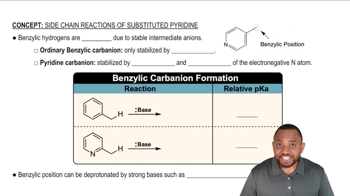
 2:36
2:36