Back

Review of Nitriles definitions

Control buttons has been changed to "navigation" mode.
1/15
  • Nitrile

    A functional group featuring a carbon triple-bonded to nitrogen, often synthesized from alkyl halides, cyanohydrins, or amides.
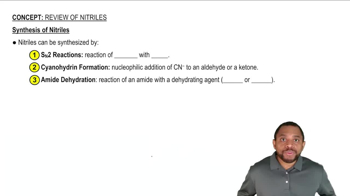
  • SN2 Reaction

    A substitution process where a nucleophile displaces a leaving group with inversion of configuration at the reactive carbon.
  • Cyanide Ion

    A nucleophile with a negative charge on carbon, commonly used to introduce a nitrile group via substitution or addition.
  • Alkyl Halide

    An organic molecule containing a halogen atom bonded to an sp3 carbon, serving as a substrate for nucleophilic substitution.
  • Cyanohydrin

    A compound formed by nucleophilic addition of cyanide to a carbonyl, resulting in a chiral center with both hydroxyl and nitrile groups.
  • Amide

    A functional group with a carbonyl bonded to nitrogen, which can be dehydrated to yield a nitrile.
  • Dehydrating Agent

    A substance like Diphosphorus Pentoxide or Thionyl Chloride used to remove water, facilitating conversion of amides to nitriles.
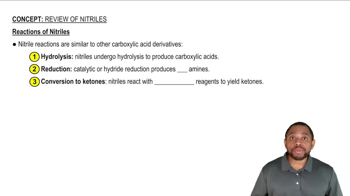
  • Hydrolysis

    A reaction where water cleaves a nitrile, producing either a carboxylic acid in acid or a carboxylate anion in base.
  • Carboxylic Acid

    A product of nitrile hydrolysis under acidic conditions, featuring a carbonyl and hydroxyl group on the same carbon.
  • Carboxylate Anion

    A negatively charged species formed when a nitrile undergoes basic hydrolysis, resulting in a deprotonated carboxylic acid.
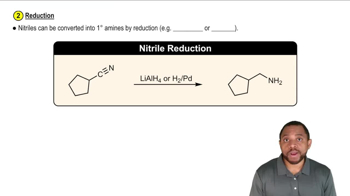
  • Reduction

    A process converting a nitrile to a primary amine, typically using lithium aluminum hydride or catalytic hydrogenation.
  • Primary Amine

    A compound with a nitrogen bonded to one carbon and two hydrogens, produced by complete reduction of a nitrile.
  • Grignard Reagent

    An organomagnesium compound that adds to nitriles, forming intermediates that yield ketones after hydrolysis.
  • Ketone

    A carbonyl-containing compound generated by reacting a nitrile with a Grignard reagent followed by hydrolysis.
  • Inversion of Configuration

    A stereochemical outcome of SN2 reactions where the spatial arrangement at the reactive center is flipped.