Back

Reactions of Amino Acids: Ninhydrin Test quiz

Control buttons has been changed to "navigation" mode.
1/15
  • What compound reacts with amino acids to produce a visible dye in the Ninhydrin test?

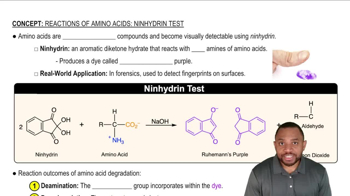
    Ninhydrin reacts with amino acids to produce a purple dye called Ruhemann’s purple.
  • What is the ratio of ninhydrin to amino acid in the Ninhydrin test reaction?

    Two moles of ninhydrin react with one mole of amino acid.
  • What color is produced when amino acids react with ninhydrin?

    A purple color, known as Ruhemann’s purple, is produced.
  • What functional group in amino acids does ninhydrin primarily react with?

    Ninhydrin primarily reacts with the primary amine group of amino acids.
  • What happens to the amino group of the amino acid during the Ninhydrin reaction?

    The amino group is incorporated into the dye formed during the reaction.
  • What happens to the carboxyl group of the amino acid in the Ninhydrin test?

    The carboxyl group is released as carbon dioxide (CO2).
  • What is formed from the alpha carbon of the amino acid in the Ninhydrin reaction?

    The alpha carbon forms an aldehyde as a byproduct.
  • What is the real-world application of the Ninhydrin test in forensic science?

    It is used to detect fingerprints by reacting with amino acids in sweat left on surfaces.
  • What is the structure of ninhydrin described as?

    Ninhydrin is an aromatic diketone hydrate featuring a geminal diol.
  • What is a geminal diol?

    A geminal diol is a compound where two hydroxyl groups are attached to the same carbon atom.
  • What are the three main outcomes of amino acid degradation in the Ninhydrin test?

    The outcomes are deamination, decarboxylation, and aldehyde formation.
  • What is the role of sodium hydroxide in the Ninhydrin test?

    Sodium hydroxide acts as a base to facilitate the reaction.
  • What is the significance of Ruhemann’s purple in analytical chemistry?

    Ruhemann’s purple indicates the presence of primary amines and is used for amino acid detection.
  • What byproducts are formed besides the dye in the Ninhydrin reaction?

    Aldehyde and carbon dioxide are formed as byproducts.
  • Why is the Ninhydrin test important for detecting amino acids?

    It allows for the visible detection of amino acids due to the formation of a colored dye.