Back

Reactions of Amino Acids: Ninhydrin Test definitions

Control buttons has been changed to "navigation" mode.
1/14
  • Amino Acid

    A carboxyl-containing compound with a primary amine group, detectable by specific colorimetric reactions.
  • Ninhydrin

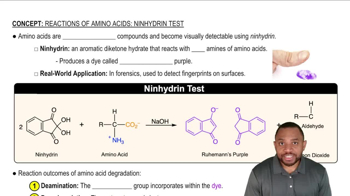
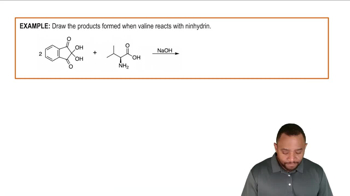
    An aromatic diketone hydrate with a geminal diol, used to visualize primary amines by forming a colored dye.
  • Aromatic Diketone

    A molecule featuring a benzene ring bonded to two carbonyl groups, crucial for certain analytical reactions.
  • Geminal Diol

    A structure where two hydroxyl groups are attached to the same carbon, present in hydrated ninhydrin.
  • Primary Amine

    A functional group with a nitrogen atom bonded to one carbon, essential for color development in detection tests.
  • Ruhemann’s Purple

    A vivid purple dye formed when ninhydrin reacts with amino acids, enabling visual detection.
  • Deamination

    A process where the amino group is removed and incorporated into a dye during a chemical reaction.
  • Decarboxylation

    A reaction step where the carboxyl group is released as carbon dioxide from an amino acid.
  • Aldehyde Formation

    A transformation where the alpha carbon of an amino acid gains a double-bonded oxygen, yielding an aldehyde.
  • Alpha Carbon

    The central carbon in an amino acid, which forms an aldehyde during specific degradation reactions.
  • Sodium Hydroxide

    A base used to facilitate the reaction between ninhydrin and amino acids, promoting dye formation.
  • Forensic Science

    A field utilizing chemical tests like ninhydrin to reveal fingerprints via amino acids in sweat.
  • Fingerprint Visualization

    A technique where latent prints become visible due to reactions between ninhydrin and amino acids.
  • Carbon Dioxide

    A gaseous byproduct released from the carboxyl group during amino acid degradation in detection tests.