What is hydrogenolysis in the context of amino acid reactions?
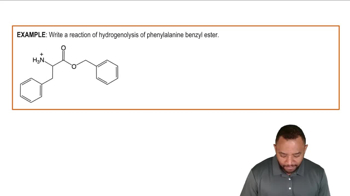
Hydrogenolysis is the cleavage of a bond through catalytic hydrogenation, typically using H2 and a metal catalyst, to break down benzyl esters and N-Cbz derivatives.
Which bond is cleaved during hydrogenolysis of benzyl esters?
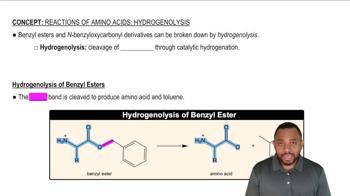
The carbon-oxygen (C–O) bond is cleaved during hydrogenolysis of benzyl esters.
What are the typical products of hydrogenolysis of benzyl esters?
The products are an amino acid and toluene.
Which metal catalysts are commonly used in hydrogenolysis reactions?
Palladium, nickel, and platinum are commonly used, with palladium being the most frequent choice.
What happens to the CH2 group in benzyl esters during hydrogenolysis?
The CH2 group gains a hydrogen to become CH3, forming toluene.
How does hydrogenolysis differ from typical catalytic hydrogenation of alkenes?
Hydrogenolysis cleaves C–O bonds and adds hydrogens to oxygen and carbon, rather than just adding hydrogens to pi bonds.
What is the abbreviation for N-benzyl oxycarbonyl derivatives?
N-benzyl oxycarbonyl derivatives are abbreviated as N-Cbz.
What intermediate is formed during hydrogenolysis of N-Cbz derivatives?
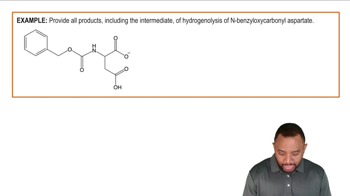
An unstable carbamic acid intermediate is formed.
What happens to carbamic acid after it is formed in N-Cbz hydrogenolysis?
Carbamic acid immediately undergoes decarboxylation, releasing CO2 and producing the free amino acid.
What is released during the decarboxylation of carbamic acid?
CO2 (carbon dioxide) is released.
What is the final product after hydrogenolysis and decarboxylation of N-Cbz derivatives?
The final product is a free amino acid.
What role does hydrogenolysis play in amino acid synthesis?
Hydrogenolysis is crucial for selective bond cleavage and reduction, aiding in amino acid synthesis and protecting group removal.
What is toluene and how is it formed in these reactions?
Toluene is benzene with a methyl group, formed when the CH2 group gains a hydrogen during hydrogenolysis.
Why is carbamic acid considered unstable in these reactions?
Carbamic acid is unstable because it rapidly decarboxylates, losing CO2 to form the amino acid.
What is the significance of catalytic hydrogenation in hydrogenolysis beyond alkene reactions?
Catalytic hydrogenation in hydrogenolysis demonstrates selective bond cleavage and reduction, not just syn addition to pi bonds.