Back

Reactions of Amino Acids: Hydrogenolysis definitions

Control buttons has been changed to "navigation" mode.
1/15
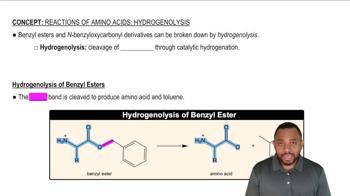
  • Hydrogenolysis

    Cleavage of single bonds using hydrogen and a metal catalyst, often yielding simpler molecules from protected amino acids.
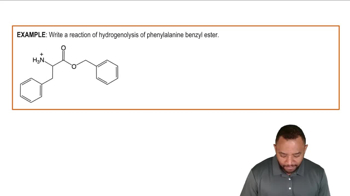
  • Benzyl Ester

    A carboxylic acid derivative where the carboxyl group is bonded to a benzyl group, commonly used as a protecting group.
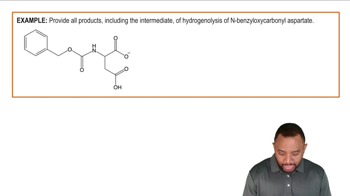
  • N-Benzyloxycarbonyl

    A protecting group for amino groups, abbreviated as N-Cbz, removable by catalytic hydrogenation.
  • Catalytic Hydrogenation

    A reaction using hydrogen gas and a metal catalyst to add hydrogens or cleave bonds in organic molecules.
  • Palladium

    A metal catalyst frequently used with hydrogen gas to facilitate selective bond cleavage in organic synthesis.
  • Toluene

    An aromatic hydrocarbon with a methyl group attached to benzene, produced as a byproduct in hydrogenolysis.
  • Carbamic Acid

    An unstable intermediate formed during N-Cbz hydrogenolysis, which rapidly loses CO2 to yield an amino acid.
  • Decarboxylation

    A process where a carboxyl group is removed from a molecule as carbon dioxide, often occurring spontaneously in unstable acids.
  • Amino Acid

    A molecule containing both amino and carboxylic acid groups, often the final product after protecting group removal.
  • Protecting Group

    A chemical group temporarily added to a molecule to prevent unwanted reactions during a synthetic sequence.
  • Reduction

    A chemical process involving the gain of hydrogen or loss of oxygen, often used to break bonds in organic molecules.
  • Metal Catalyst

    A substance like palladium, nickel, or platinum that accelerates hydrogen addition or bond cleavage without being consumed.
  • C–O Bond

    A single bond between carbon and oxygen atoms, targeted for cleavage in hydrogenolysis of esters and carbamates.
  • Syn Addition

    A process where two atoms or groups add to the same side of a double bond or, in this context, to adjacent atoms during hydrogenation.
  • CO2

    A gaseous byproduct released during decarboxylation of carbamic acid in the hydrogenolysis of N-Cbz derivatives.