Organic Chemistry
My Course
Learn
Exam Prep
AI Tutor
Study Guides
Textbook Solutions
Flashcards
Explore
Try the app
My Course
Learn
Exam Prep
AI Tutor
Study Guides
Textbook Solutions
Flashcards
Explore
Try the app
Back
Reactions of Amino Acids: Acylation quiz
You can tap to flip the card.
What functional group is formed when the amino group of an amino acid undergoes acylation?
You can tap to flip the card.
👆
What functional group is formed when the amino group of an amino acid undergoes acylation?
An amide functional group is formed.
Track progress
Control buttons has been changed to "navigation" mode.
1/15
Related flashcards
Related practice
Recommended videos
Reactions of Amino Acids: Acylation definitions
Reactions of Amino Acids: Acylation
13 Terms
26. Amino Acids, Peptides, and Proteins
5 topics
13 problems
Chapter
Johnny
1:01
Reactions of Amino Acids: Acylation Example 1
1
views
1:40
Reactions of Amino Acids: Acylation Concept 1
1
views
Terms in this set (15)
Hide definitions
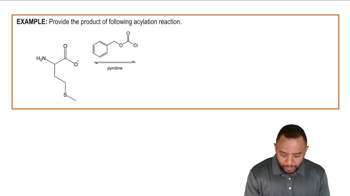
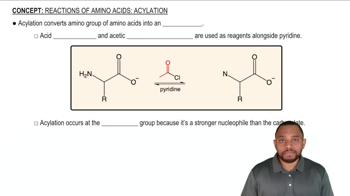
What functional group is formed when the amino group of an amino acid undergoes acylation?
An amide functional group is formed.
Which reagents are commonly used for the acylation of amino acids?
Acid chlorides or acetic anhydrides are commonly used, often in the presence of pyridine.
Why does acylation occur at the amine group of an amino acid rather than the carboxylate group?
Because the amine group is a stronger nucleophile than the carboxylate group.
What is the role of pyridine in the acylation reaction of amino acids?
Pyridine acts as a base to neutralize the acid byproduct and facilitate the reaction.
What type of reaction mechanism is involved in the acylation of amino acids?
The reaction involves nucleophilic acyl substitution.
What happens to one of the hydrogens on the nitrogen during acylation?
One hydrogen is replaced by the acyl group, while another hydrogen remains attached to the nitrogen.
What would be formed if acylation occurred at the carboxylate group instead of the amine group?
An anhydride would be formed instead of an amide.
What is the significance of the acyl group in the acylation reaction?
The acyl group replaces a hydrogen on the nitrogen, forming an amide bond.
Why are acid chlorides considered good reagents for acylation?
Acid chlorides are highly reactive carboxylic acid derivatives, making them effective for acylation.
How does the nucleophilicity of the amine group affect the outcome of the acylation reaction?
The higher nucleophilicity of the amine group ensures it reacts preferentially with the acylating agent.
What is the main product when an amino acid reacts with acetic anhydride?
The main product is an N-acetylated amino acid, which is an amide.
In the context of organic synthesis, why is understanding acylation important?
It is crucial for manipulating amino acid reactivity in both biochemical and synthetic applications.
What type of bond is formed between the nitrogen and the acyl group during acylation?
An amide bond is formed.
What is the fate of the carboxyl group during the acylation of an amino acid?
The carboxyl group remains unchanged during the acylation of the amino group.
What would happen if the nucleophilicity of the carboxylate group was higher than the amine group?
Acylation would occur at the carboxylate group, leading to the formation of an anhydride instead of an amide.