Organic Chemistry
My Course
Learn
Exam Prep
AI Tutor
Study Guides
Textbook Solutions
Flashcards
Explore
Try the app
My Course
Learn
Exam Prep
AI Tutor
Study Guides
Textbook Solutions
Flashcards
Explore
Try the app
Back
Reactions of Amino Acids: Acylation definitions
You can tap to flip the card.
Acylation
You can tap to flip the card.
👆
Acylation
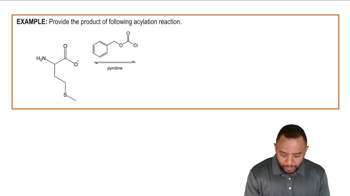
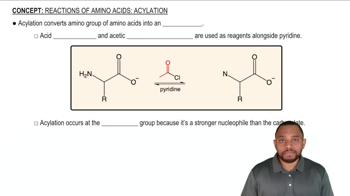
Transformation where an acyl group is introduced, typically converting an amino group into an amide in amino acids.
Track progress
Control buttons has been changed to "navigation" mode.
1/13
Related flashcards
Related practice
Recommended videos
Reactions of Amino Acids: Acylation quiz
Reactions of Amino Acids: Acylation
15 Terms
26. Amino Acids, Peptides, and Proteins
5 topics
13 problems
Chapter
Johnny
1:01
Reactions of Amino Acids: Acylation Example 1
1
views
1:40
Reactions of Amino Acids: Acylation Concept 1
1
views
Terms in this set (13)
Hide definitions
Acylation
Transformation where an acyl group is introduced, typically converting an amino group into an amide in amino acids.
Amino Group
Functional group in amino acids that acts as a strong nucleophile, favoring reaction with acylating agents.
Amide
Product formed when an acyl group replaces a hydrogen on nitrogen, resulting from acylation of an amino group.
Acid Chloride
Reactive carboxylic acid derivative commonly used to introduce acyl groups during acylation reactions.
Acetic Anhydride
Acylating agent that reacts with amino groups to form amides, often used in the presence of pyridine.
Pyridine
Basic organic compound used as a catalyst or base to facilitate acylation by neutralizing byproducts.
Nucleophile
Species with a strong tendency to donate electrons, such as the amino group in amino acids during acylation.
Carboxylate Ion
Deprotonated form of a carboxylic acid group, less nucleophilic than the amino group in acylation reactions.
Nucleophilic Acyl Substitution
Mechanism where a nucleophile replaces a leaving group on an acyl compound, forming a new bond.
Amide Bond
Covalent linkage formed between a carbonyl carbon and a nitrogen, characteristic of acylated amino acids.
Acyl Group
Moiety derived from a carboxylic acid, introduced onto nitrogen during acylation to form an amide.
Carboxylic Acid Derivative
Compound structurally related to carboxylic acids, such as acid chlorides, used in acylation.
Anhydride
Functional group that could form if acylation occurred at the carboxylate instead of the amino group.