Back

Reactions at Benzylic Positions quiz

Control buttons has been changed to "navigation" mode.
1/15
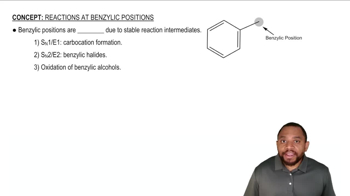
  • What is the benzylic position in an aromatic compound?

    The benzylic position is the carbon atom directly attached to a benzene ring.
  • Why are benzylic positions highly reactive in organic reactions?

    They are highly reactive due to the resonance stabilization of reaction intermediates formed at this position.
  • What is the rate-determining step in SN1 and E1 reactions at benzylic positions?

    The rate-determining step is the formation of a carbocation intermediate.
  • How does the rate of benzylic carbocation formation compare to non-benzylic carbocations?

    Benzylic carbocations form much faster than non-benzylic carbocations due to resonance stabilization.
  • What effect do electron-donating groups at the ortho and para positions have on SN1 reactions at benzylic positions?

    Electron-donating groups at these positions increase the rate of SN1 reactions by providing additional electron density through resonance or inductive effects.
  • How do alkyl groups attached to a benzene ring affect SN1 rates at the benzylic position?

    Alkyl groups donate electrons through the inductive effect, which helps to speed up SN1 rates at the benzylic position.
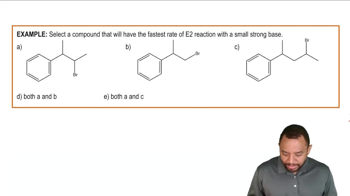
  • What is the major product of E2 elimination reactions of benzylic halides?

    The major product is a conjugated alkene, which is stabilized by resonance.
  • Why are benzylic beta-hydrogens more acidic than other beta-hydrogens?

    They are more acidic because the resulting anion is stabilized by resonance with the benzene ring.
  • What role does a strong base play in E2 reactions of benzylic halides?

    A strong base removes a beta-hydrogen, leading to the formation of a double bond (alkene) via elimination.
  • What is a minor product that can form during E2 reactions of primary benzylic halides?

    A minor product is formed by substitution (SN2), where the nucleophile replaces the halide.
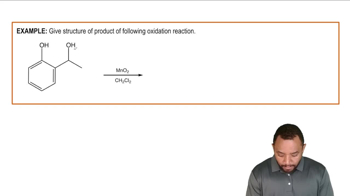
  • What reagent is commonly used to selectively oxidize benzylic alcohols?

    Manganese(IV) oxide (MnO2) in dichloromethane is commonly used for this selective oxidation.
  • What is the product of oxidizing a benzylic alcohol with MnO2?

    The product is a benzylic aldehyde, such as benzaldehyde.
  • Why are benzylic alcohols more reactive toward oxidation than non-benzylic alcohols?

    Benzylic alcohols are more reactive due to the resonance stabilization of the intermediate formed during oxidation.
  • What structural feature allows conjugated alkenes formed from benzylic E2 reactions to be especially stable?

    Conjugation with the benzene ring allows for resonance stabilization, making the alkene especially stable.
  • How does resonance contribute to the reactivity of benzylic positions in organic reactions?

    Resonance delocalizes charge or electrons, stabilizing intermediates and increasing the rate of reactions at the benzylic position.