An intramolecular reaction occurs within the same molecule, as opposed to between two different molecules.
How does the rate of intramolecular reactions compare to intermolecular reactions?
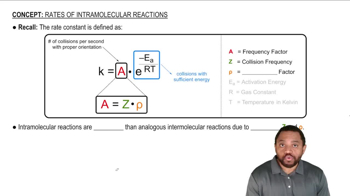
Intramolecular reactions are generally faster than intermolecular reactions due to higher collision frequency and better orientation.
What is the rate constant (k) equation in terms of the frequency factor (A) and activation energy (Ea)?
The rate constant k is given by k = A × e^(-Ea/RT), where A is the frequency factor, Ea is activation energy, R is the gas constant, and T is temperature in Kelvin.
What two factors make up the frequency factor (A) in the rate equation?
The frequency factor A is the product of collision frequency (z) and orientation factor (ρ), so A = z × ρ.
What does the collision frequency (z) represent?
Collision frequency (z) represents how often molecules collide with each other per second.
What does the orientation factor (ρ) represent?
The orientation factor (ρ) represents the fraction of collisions that occur with the correct orientation for a reaction to take place.
Why do intramolecular reactions have higher collision frequency (z) than intermolecular reactions?
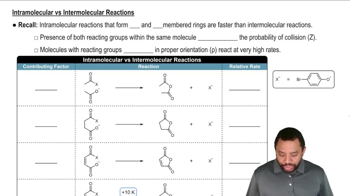
Because the reacting groups are part of the same molecule, they are more likely to collide frequently.
How does the orientation factor (ρ) differ in intramolecular versus intermolecular reactions?
In intramolecular reactions, the orientation factor is higher because the reacting groups are more likely to be properly aligned.
What effect does forming a 5- or 6-membered ring have on the rate of an intramolecular reaction?
Forming a 5- or 6-membered ring significantly increases the reaction rate due to favorable geometry and ring stability.
How does increasing the temperature by 10 Kelvin affect the rate of a reaction?
Increasing the temperature by 10 Kelvin typically doubles the rate of the reaction.
What happens to the rate of reaction when both collision frequency and orientation are optimized in an intramolecular reaction?
The rate of reaction increases dramatically when both collision frequency and orientation are optimized.
Why does locking reacting groups in place (e.g., with a double bond) increase the rate of intramolecular reactions?
Locking groups in place increases the orientation factor, making successful collisions more likely and thus increasing the rate.
What is the relative rate of an intermolecular reaction compared to an intramolecular reaction forming a 5-membered ring?
The relative rate of an intermolecular reaction is much lower (e.g., 1) compared to an intramolecular reaction forming a 5-membered ring (e.g., 2.2 × 10^5 or higher).
How do changes in chain length or the identity of the leaving group (X) affect the relative rate of intramolecular reactions?
Changing the chain length or the leaving group alters the relative rate, as these factors affect the likelihood of collision and proper orientation.
What three main factors can combine to drastically increase the rate of an intramolecular reaction?
Collision frequency (z), orientation factor (ρ), and increased temperature can combine to greatly increase the reaction rate.