Back

Rates of Intramolecular Reactions definitions

Control buttons has been changed to "navigation" mode.
1/15
  • Intramolecular Reaction

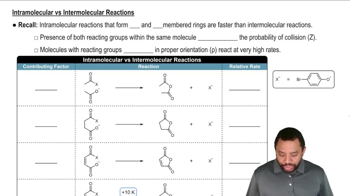
    A process where reacting groups within a single molecule interact, leading to higher reaction rates due to increased collision probability.
  • Intermolecular Reaction

    A process involving interactions between separate molecules, typically resulting in slower reaction rates.
  • Rate Constant

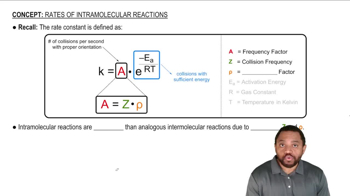
    A proportionality factor (k) in the rate equation, influenced by activation energy, temperature, and molecular collisions.
  • Activation Energy

    The minimum energy required for reactants to successfully transform into products during a chemical reaction.
  • Frequency Factor

    A component (A) in the Arrhenius equation, representing the product of collision frequency and orientation factor.
  • Collision Frequency

    The number of times reactant molecules encounter each other per second, impacting the likelihood of reaction.
  • Orientation Factor

    A measure of how favorably molecules are aligned during collisions, affecting the probability of a successful reaction.
  • Relative Rate

    A comparison of reaction speeds under different conditions, highlighting the influence of molecular structure and environment.
  • Ring Formation

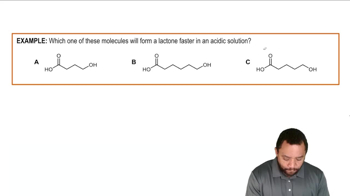
    The creation of cyclic structures, especially 5 or 6-membered rings, which significantly accelerates reaction rates.
  • Temperature

    A variable that, when increased by 10 Kelvin, can approximately double the rate of a chemical reaction.
  • Gas Constant

    A physical constant (R) used in kinetic equations, relating energy scale to temperature and amount of substance.
  • Kelvin

    The SI unit for temperature, crucial for expressing thermal energy in reaction rate calculations.
  • Pi Bond

    A type of covalent bond that restricts rotation, locking groups in place and enhancing orientation for reactions.
  • Chain Length

    The number of atoms in a molecular backbone, which can alter the rate and outcome of intramolecular reactions.
  • Leaving Group

    An atom or group that departs from a molecule during a reaction, influencing the reaction's mechanism and rate.