Back

Protecting Alcohols from Organometallics quiz

Control buttons has been changed to "navigation" mode.
1/15
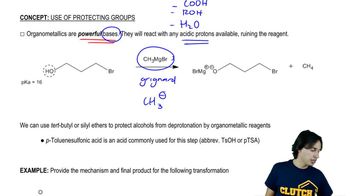
  • Why do organometallic reagents like Grignards react with alcohols?

    Organometallics are strong bases and react with the acidic proton of alcohols, leading to unwanted acid-base reactions.
  • What is the main limitation of organometallic reagents in organic synthesis?

    They tend to cross-react with acidic hydrogens, which can deactivate the reagent and prevent the desired reaction.
  • What types of functional groups contain acidic protons that can interfere with organometallics?

    Alcohols, carboxylic acids, and water all contain acidic protons that can react with organometallic reagents.
  • What is the purpose of using protecting groups in reactions with organometallics?

    Protecting groups are used to prevent alcohols from reacting with organometallic reagents by masking their acidic protons.
  • Name two common types of protecting groups for alcohols.

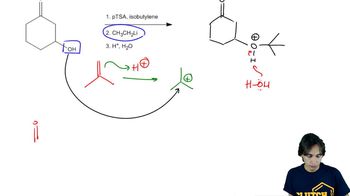
    Tert-butyl ethers and silyl ethers are two common protecting groups for alcohols.
  • What happens if a Grignard reagent reacts with an alcohol instead of the intended electrophile?

    An acid-base reaction occurs, producing methane (CH4) and deactivating the Grignard reagent.
  • What is the typical pKa value of an alcohol proton that allows it to react with Grignard reagents?

    The pKa of an alcohol is around 16, which is acidic enough to react with Grignard reagents.
  • What is the role of para-toluenesulfonic acid (TsOH or PTSA) in protecting alcohols?

    TsOH or PTSA acts as an acid catalyst to help form an ether, thereby protecting the alcohol.
  • How does protecting an alcohol prevent it from being deprotonated by an organometallic reagent?

    Protection converts the alcohol into an ether, which lacks an acidic proton and cannot be deprotonated.
  • What is the abbreviation for para-toluenesulfonic acid commonly used in textbooks?

    It is abbreviated as TsOH or PTSA.
  • What is the fate of the Grignard reagent if it reacts with an alcohol's proton?

    It forms methane and a deactivated Grignard, preventing the intended nucleophilic reaction.
  • Why is it important to protect alcohols before adding organometallic reagents in synthesis?

    Protection ensures that the organometallic reagent reacts with the intended electrophile, not the alcohol.
  • What is formed when an alcohol is protected using a silyl ether?

    A silyl ether is formed, which masks the alcohol's proton and prevents unwanted reactions.
  • What is the general outcome of a protection reaction involving an alcohol and an acid catalyst?

    An ether is formed, which protects the alcohol from reacting with organometallics.
  • What is the spectator ion formed when a Grignard reagent reacts with an alcohol?

    MgBr+ acts as a spectator ion and associates with the resulting alkoxide.