Back

Protecting Alcohols from Organometallics definitions

Control buttons has been changed to "navigation" mode.
1/15
  • Organometallics

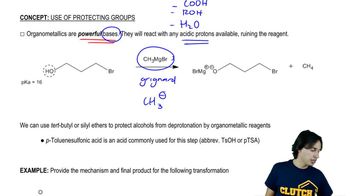
    Highly reactive compounds containing metal-carbon bonds, often acting as strong bases and nucleophiles in organic synthesis.
  • Grignard Reagent

    A magnesium-containing organometallic compound, typically used for nucleophilic addition to electrophiles in organic reactions.
  • Acidic Proton

    A hydrogen atom attached to an electronegative atom, easily removed by strong bases, often interfering with organometallic reactions.
  • Protecting Group

    A chemical modification temporarily masking a reactive site, preventing unwanted reactions during multi-step syntheses.
  • Alcohol

    An organic functional group featuring a hydroxyl group, often requiring protection due to its reactivity with strong bases.
  • Carboxylic Acid

    A functional group with a carbonyl and hydroxyl, highly acidic and prone to react with organometallic reagents.
  • Silyl Ether

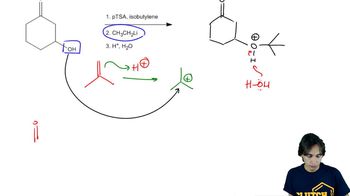
    A common protecting group for alcohols, formed by replacing the hydrogen of a hydroxyl with a silyl group.
  • TBS Ether

    A specific silyl ether derived from tert-butyldimethylsilyl chloride, frequently used to protect alcohols.
  • Para-Toluenesulfonic Acid

    A strong organic acid, often abbreviated as TsOH or PTSA, used to catalyze protection reactions of alcohols.
  • Alkyl Halide

    An organic molecule containing a halogen atom bonded to an alkyl group, serving as a typical electrophile in SN2 reactions.
  • Electrophile

    A species with a partial or full positive charge, attracting nucleophiles in chemical reactions.
  • Nucleophile

    A species rich in electrons, seeking positively charged or electron-deficient centers to form new bonds.
  • SN2 Reaction

    A bimolecular nucleophilic substitution mechanism, characterized by a single concerted step and inversion of configuration.
  • Deprotonation

    The removal of a proton from a molecule, often by a strong base, altering the molecule's reactivity.
  • Spectator Ion

    An ion present during a reaction that does not participate in the chemical transformation but maintains charge balance.