Back

Preparation of Organometallics quiz

Control buttons has been changed to "navigation" mode.
1/15
  • What is an organometallic compound?

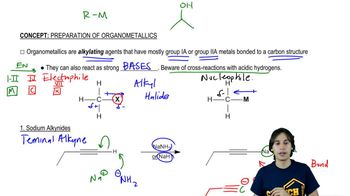
    An organometallic compound is an alkylating agent consisting of a Group 1A or 2A metal bonded to a carbon structure, making the carbon highly nucleophilic.
  • Why is the carbon in organometallics considered a good nucleophile?

    Because the metal bonded to carbon is less electronegative, the carbon gains a partial negative charge, making it an excellent nucleophile.
  • What is the general formula used to represent organometallics?

    The general formula is RM, where R is a carbon group with a negative charge and M is a Group 1A or 2A metal with a positive charge.
  • How are sodium alkanides prepared?

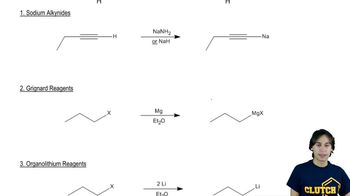
    Sodium alkanides are formed by reacting a terminal alkyne with a strong base like NaNH2 or NaH, which removes the acidic hydrogen and creates a negatively charged carbon.
  • What type of bond exists between sodium and carbon in sodium alkanides?

    The bond is ionic, due to the large difference in electronegativity between sodium and carbon.
  • How is a Grignard reagent prepared?

    A Grignard reagent is made by reacting an alkyl halide with elemental magnesium in diethyl ether, resulting in a carbon-magnesium bond.
  • What is the typical halogen used in Grignard reagent preparation?

    Bromine is most commonly used, but chlorine and iodine are also suitable; fluorine is rarely used.
  • How is an organolithium compound prepared?

    Organolithium compounds are prepared by reacting an alkyl halide with two equivalents of elemental lithium, directly attaching lithium to the carbon.
  • What is the key difference between Grignard and organolithium reagents?

    Grignard reagents use magnesium and usually retain a halogen, while organolithium compounds use lithium and attach it directly to carbon without a halogen.
  • How are Gilman reagents (lithium dialkylcuprates) prepared?

    Gilman reagents are formed by reacting an alkyl halide with lithium to make organolithium, then combining two organolithium units with copper iodide.
  • What is the structure of a Gilman reagent?

    A Gilman reagent consists of two alkyl groups bonded to copper, with lithium as a counterion, following the general RM structure.
  • Why must organometallics be kept away from molecules with acidic hydrogens?

    Organometallics are strong bases and can deprotonate molecules with acidic hydrogens, leading to unwanted side reactions and deactivation.
  • What happens when an organometallic reacts with an alcohol?

    The organometallic deprotonates the alcohol, resulting in a ruined reagent and preventing the desired nucleophilic reaction.
  • What are the four main types of organometallics discussed?

    The four types are sodium alkanides, Grignard reagents, organolithium compounds, and Gilman reagents.
  • What is the main property that distinguishes organometallics from typical carbon compounds?

    Organometallics have carbon with a negative charge, making it a strong nucleophile, unlike typical carbon compounds where carbon is often electrophilic.