Back

Preparation of Organometallics definitions

Control buttons has been changed to "navigation" mode.
1/15
  • Organometallics

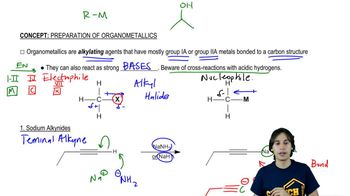
    Alkylating agents with a Group 1A or 2A metal bonded to carbon, making the carbon highly nucleophilic and reactive in organic synthesis.
  • Alkylating Agent

    A compound capable of transferring an alkyl group to another molecule, often used to build larger carbon frameworks.
  • Group 1A Metal

    An element from the first column of the periodic table, such as sodium or lithium, commonly used in organometallic formation.
  • Group 2A Metal

    An element from the second column of the periodic table, like magnesium, often forming bonds with carbon in organometallics.
  • Nucleophile

    A species with a negative charge or lone pair, seeking positively charged or electron-deficient centers to form new bonds.
  • Sodium Alkanide

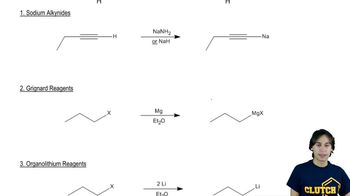
    A compound formed by reacting a terminal alkyne with a strong base, resulting in a negatively charged carbon bonded to sodium.
  • Grignard Reagent

    A compound produced by reacting an alkyl halide with magnesium in ether, yielding a carbon-magnesium bond with nucleophilic character.
  • Organolithium Compound

    A molecule created by reacting an alkyl halide with lithium, directly attaching lithium to a carbon, enhancing nucleophilicity.
  • Gilman Reagent

    A lithium dialkylcuprate formed by combining organolithium with copper iodide, used for coupling reactions in synthesis.
  • Alkyl Halide

    A molecule containing a carbon bonded to a halogen, serving as a precursor in organometallic reagent preparation.
  • Diethyl Ether

    A solvent with two ethyl groups bonded to oxygen, commonly used to stabilize organometallic reagents during synthesis.
  • Ionic Bond

    A bond formed by a large electronegativity difference, resulting in minimal electron sharing and easy dissociation into ions.
  • Acidic Hydrogen

    A proton attached to a molecule, such as alcohol or water, that can be easily removed by a strong base or nucleophile.
  • Spectator Ion

    An ion present during a reaction that does not participate in the main chemical change, often balancing charge.
  • Electrophile

    A species with a partial or full positive charge, attracting nucleophiles to form new chemical bonds.