Organic Chemistry
My Course
Learn
Exam Prep
AI Tutor
Study Guides
Textbook Solutions
Flashcards
Explore
Try the app
My Course
Learn
Exam Prep
AI Tutor
Study Guides
Textbook Solutions
Flashcards
Explore
Try the app
Back
Peptide Sequencing: Partial Hydrolysis with Cyanogen Bromide quiz
You can tap to flip the card.
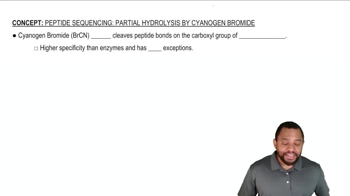
What specific amino acid does cyanogen bromide (BrCN) cleave at in peptide sequencing?
You can tap to flip the card.
👆
What specific amino acid does cyanogen bromide (BrCN) cleave at in peptide sequencing?
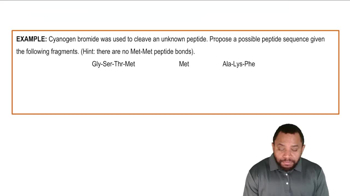
Cyanogen bromide specifically cleaves at the carboxyl side of methionine residues in peptides.
Track progress
Control buttons has been changed to "navigation" mode.
1/15
Related flashcards
Recommended videos
Peptide Sequencing: Partial Hydrolysis with Cyanogen Bromide definitions
Peptide Sequencing: Partial Hydrolysis with Cyanogen Bromide
15 Terms
0:53
Peptide Sequencing: Partial Hydrolysis with Cyanogen Bromide Concept 1
1
views
1:44
Peptide Sequencing: Partial Hydrolysis with Cyanogen Bromide Example 1
2
views
4:17
Peptide Sequencing: Partial Hydrolysis with Cyanogen Bromide Concept 2
1
views
Terms in this set (15)
Hide definitions
What specific amino acid does cyanogen bromide (BrCN) cleave at in peptide sequencing?
Cyanogen bromide specifically cleaves at the carboxyl side of methionine residues in peptides.
What type of reaction initiates the cleavage mechanism of cyanogen bromide with methionine?
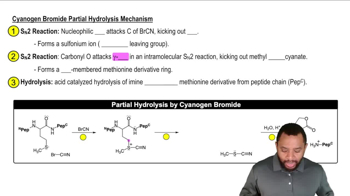
The mechanism begins with an SN2 nucleophilic attack by the sulfur atom of methionine on the carbon of cyanogen bromide.
What is formed after the sulfur of methionine attacks cyanogen bromide in the first step?
A sulfonium ion intermediate is formed after the nucleophilic attack.
What happens to the bromine atom during the first step of the cyanogen bromide reaction?
The bromine atom acts as a leaving group and is expelled from the molecule.
What type of reaction occurs in the second step of the cyanogen bromide mechanism?
An intramolecular SN2 reaction occurs, where the carbonyl oxygen attacks the gamma carbon.
What is the result of the intramolecular SN2 reaction in the cyanogen bromide mechanism?
A five-membered methionine derivative ring is formed.
What small molecule is released during the ring formation step of the mechanism?
Methylthiocyanate is released during the formation of the five-membered ring.
What functional group is cleaved during the acid-catalyzed hydrolysis step?
The imine group (C=N) is cleaved during acid-catalyzed hydrolysis.
What is regenerated on the peptide fragment after acid hydrolysis?
The carbonyl group is regenerated on the peptide fragment.
Why is cyanogen bromide considered highly specific in peptide sequencing?
It only cleaves at methionine residues with no exceptions, making it extremely precise.
What is the importance of labeling the alpha, beta, and gamma carbons in the mechanism?
Labeling these carbons helps track the formation of the five-membered ring during the reaction.
What does the partial hydrolysis by cyanogen bromide help achieve in protein chemistry?
It aids in analyzing peptide structure and sequence by generating specific peptide fragments.
What is the role of acid in the final step of the cyanogen bromide mechanism?
Acid catalyzes the hydrolysis of the imine, cleaving the methionine derivative from the peptide chain.
What happens to the nitrogen atom after acid hydrolysis in the mechanism?
The nitrogen atom becomes protonated, gaining two hydrogens.
How does cyanogen bromide cleavage compare to enzymatic cleavage in terms of specificity?
Cyanogen bromide is even more specific than most enzymes, as it only cleaves at methionine residues.