Back

Peptide Sequencing: Partial Hydrolysis with Cyanogen Bromide definitions

Control buttons has been changed to "navigation" mode.
1/15
  • Cyanogen Bromide

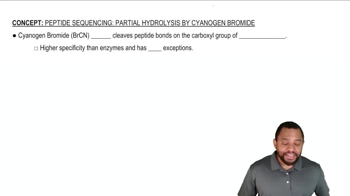
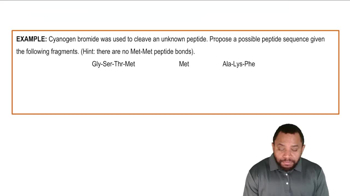
    A reagent that cleaves peptide bonds specifically at the carboxyl side of methionine, enabling precise peptide fragmentation.
  • Partial Hydrolysis

    A controlled process that breaks peptide chains at specific sites, generating fragments for sequencing analysis.
  • Peptide Sequencing

    A method for determining the order of amino acids in a peptide by analyzing fragments produced by selective cleavage.
  • Methionine

    An amino acid whose carboxyl side is targeted by cyanogen bromide for selective peptide bond cleavage.
  • SN2 Reaction

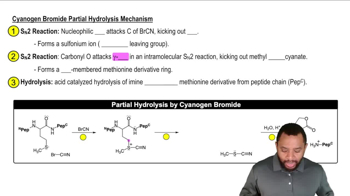
    A bimolecular nucleophilic substitution mechanism where a nucleophile attacks and displaces a leaving group in one concerted step.
  • Sulfonium Ion

    An intermediate with a positively charged sulfur atom, formed during the reaction of methionine with cyanogen bromide.
  • Methylthiocyanate

    A small molecule released during the cyclization step of cyanogen bromide-mediated peptide cleavage.
  • Five-Membered Ring

    A cyclic structure formed from methionine during the reaction, crucial for the selective cleavage process.
  • Acid-Catalyzed Hydrolysis

    A reaction step where acid facilitates the cleavage of an imine, regenerating a carbonyl and releasing peptide fragments.
  • Imine

    A functional group with a carbon-nitrogen double bond, formed transiently during the peptide cleavage mechanism.
  • Carboxyl Group

    A functional group at the end of methionine where cyanogen bromide cleaves the peptide bond.
  • Nucleophilic Substitution

    A reaction type where a nucleophile replaces a leaving group, central to the mechanism of peptide bond cleavage by cyanogen bromide.
  • Peptide Bond

    A covalent linkage between amino acids, selectively broken by cyanogen bromide at methionine residues.
  • Enzymatic Specificity

    The property of a reagent or enzyme to target and cleave peptide bonds at precise amino acid sites.
  • Gamma Carbon

    The third carbon from the functional group in methionine, involved in the intramolecular cyclization during cleavage.