Back

Ozonolysis Full Mechanism quiz

Control buttons has been changed to "navigation" mode.
1/15
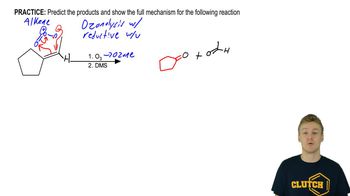
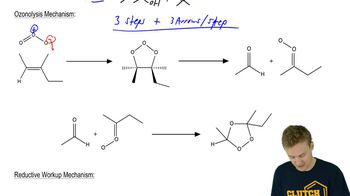
  • What is the name of the unstable cyclic intermediate formed during ozonolysis?

    The unstable cyclic intermediate is called an ozonide.
  • How many mechanistic steps are there in the general ozonolysis mechanism before the workup?

    There are three mechanistic steps in the general ozonolysis mechanism before the workup.
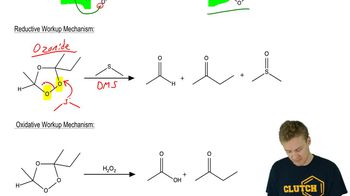
  • What are the typical reagents used for the reductive workup in ozonolysis?

    Typical reagents for the reductive workup are dimethyl sulfide (DMS) or zinc and acetic acid.
  • What is the main product formed from an alkene after ozonolysis with a reductive workup?

    The main products are aldehydes and ketones.
  • What reagent is commonly used for the oxidative workup in ozonolysis?

    Hydrogen peroxide (H2O2) is commonly used for the oxidative workup.
  • What does an oxidative workup convert an aldehyde into?

    An oxidative workup converts an aldehyde into a carboxylic acid.
  • Does the ketone product change during an oxidative workup in ozonolysis?

    No, the ketone remains unchanged during the oxidative workup.
  • In the first step of ozonolysis, what acts as the nucleophile?

    The negatively charged oxygen on ozone acts as the nucleophile.
  • What is the name of the first intermediate formed after ozone adds to an alkene?

    The first intermediate is called a molozonide.
  • How many arrows are involved in each mechanistic step of the ozonolysis mechanism?

    Each mechanistic step involves three arrows.
  • What happens to the stereochemistry of the alkene during the first step of ozonolysis?

    The stereochemistry of the alkene is retained during the first step, which is a syn addition.
  • What does DMS (dimethyl sulfide) become after the reductive workup?

    DMS is converted into DMSO (dimethyl sulfoxide) after the reaction.
  • What type of bond is formed when the negative oxygen attacks the carbonyl carbon in the third step?

    A new carbon-oxygen sigma bond is formed.
  • What is the fate of a hydrogen attached to a carbon with two oxygen sigma bonds during oxidative workup?

    That hydrogen is converted into an OH group, forming a carboxylic acid.
  • Can ozonolysis with a reductive workup produce carboxylic acids?

    No, a reductive workup produces only aldehydes and ketones, not carboxylic acids.