Back

Ozonolysis Full Mechanism definitions

Control buttons has been changed to "navigation" mode.
1/15
  • Ozonolysis

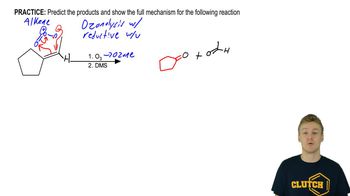
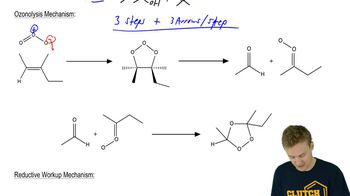
    Oxidative cleavage of alkenes using ozone, producing carbonyl compounds via unstable cyclic intermediates.
  • Ozonide

    Unstable, three-membered cyclic intermediate with three oxygens, formed after ozone adds to an alkene.
  • Molozonide

    First unstable intermediate in the reaction, formed immediately after ozone adds to an alkene double bond.
  • Reductive Workup

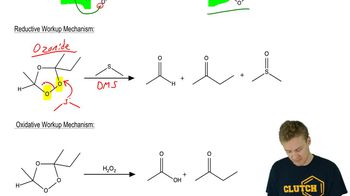
    Process using agents like DMS or zinc/acetic acid to convert ozonides into aldehydes and ketones.
  • Oxidative Workup

    Treatment with hydrogen peroxide that transforms ozonides into carboxylic acids and ketones.
  • Dimethyl Sulfide

    Common reducing agent in the reaction, attacking ozonides to yield DMSO and carbonyl products.
  • Hydrogen Peroxide

    Oxidizing agent used to convert aldehyde intermediates into carboxylic acids during the reaction.
  • Aldehyde

    Product formed from ozonolysis under reductive conditions, containing a carbonyl group bonded to hydrogen.
  • Ketone

    Product of both reductive and oxidative workups, featuring a carbonyl group bonded to two carbons.
  • Carboxylic Acid

    Compound produced from aldehydes during oxidative workup, containing a carbonyl and hydroxyl group.
  • Sigma Bond

    Single covalent bond formed by direct overlap of orbitals, broken and formed during the mechanism.
  • Pi Bond

    Bond formed by sideways overlap of p orbitals, present in alkenes and broken during the reaction.
  • Nucleophile

    Species with a negative charge or lone pair, attacking electrophilic centers in the mechanism.
  • Electrophile

    Atom or group with partial positive charge, attracting nucleophiles during bond formation.
  • Stereochemistry

    Spatial arrangement of atoms retained during the syn addition of ozone to the alkene.