Organic Chemistry
My Course
Learn
Exam Prep
AI Tutor
Study Guides
Textbook Solutions
Flashcards
Explore
Try the app
My Course
Learn
Exam Prep
AI Tutor
Study Guides
Textbook Solutions
Flashcards
Explore
Try the app
Back
Overview of Nucleophilic Addition of Solvents quiz
You can tap to flip the card.
What is the key feature that makes carbonyl carbons highly reactive in nucleophilic addition reactions?
You can tap to flip the card.
👆
What is the key feature that makes carbonyl carbons highly reactive in nucleophilic addition reactions?
The carbonyl carbon has a strong partial positive charge, making it highly susceptible to attack by nucleophiles and even neutral solvents.
Track progress
Control buttons has been changed to "navigation" mode.
1/15
Related flashcards
Related practice
Recommended videos
Overview of Nucleophilic Addition of Solvents definitions
Overview of Nucleophilic Addition of Solvents
15 Terms
19. Aldehydes and Ketones:Nucleophilic Addition - Part 1 of 3
5 topics
14 problems
Chapter
Johnny
19. Aldehydes and Ketones:Nucleophilic Addition - Part 2 of 3
1 topic
13 problems
Chapter
Johnny
19. Aldehydes and Ketones:Nucleophilic Addition - Part 3 of 3
2 topics
13 problems
Chapter
Ernest
Guided course
13:04
Nucleophilic Addition of Solvents
3
views
Terms in this set (15)
Hide definitions
What is the key feature that makes carbonyl carbons highly reactive in nucleophilic addition reactions?
The carbonyl carbon has a strong partial positive charge, making it highly susceptible to attack by nucleophiles and even neutral solvents.
Why do carbonyl reactions with neutral solvents typically require a catalyst?
These reactions need acid or base catalysts because neutral solvents are not strong nucleophiles, so catalysis helps facilitate the reaction.
What is the first step in an acid-catalyzed nucleophilic addition mechanism to a carbonyl?
The first step is protonation of the carbonyl oxygen to increase its electrophilicity.
What product forms when water reacts with a carbonyl compound in the presence of acid?
The product is a hydrate, specifically a geminal diol (gem diol).
How does the number of alcohol equivalents affect the products formed with carbonyls?
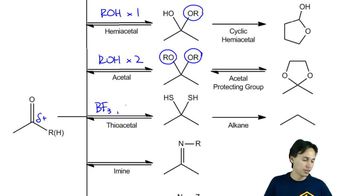
One equivalent of alcohol forms a hemiacetal, while two equivalents form an acetal.
What distinguishes a hemiacetal from an acetal structurally?
A hemiacetal has one OH and one OR group attached to the central carbon, while an acetal has two OR groups.
What reagent is used to form thioacetals from carbonyl compounds?
Thioacetals are formed using two equivalents of a thiol (RSH) and BF3 as the acid catalyst.
What is the difference between acetals and thioacetals?
Acetals have two OR groups, while thioacetals have two SH groups attached to the central carbon.
What product forms when a primary amine reacts with a carbonyl compound?
A primary amine reacts to form an imine, which has a double bond between carbon and nitrogen.
What is the product when a secondary amine reacts with a carbonyl compound?
A secondary amine forms an enamine, which features a double bond adjacent to the nitrogen atom.
Why are hemiacetals generally unstable, and when are they stable?
Hemiacetals are generally unstable unless they are cyclic, in which case they can be stable.
What is a common use for acetals in organic synthesis?
Acetals are used as protecting groups for carbonyl compounds.
How can thioacetals be converted to alkanes?
Thioacetals can be reduced to alkanes using Raney nickel as a reducing agent.
What is the Wolf-Kishner reduction, and what does it accomplish?
The Wolf-Kishner reduction uses a hydrazone derivative, strong base, and heat to convert a carbonyl into an alkane.
What type of reaction do enamines undergo with alkyl halides, and what is the result?
Enamines react with alkyl halides via SN2 to form alpha-substituted carbonyl compounds.