Back

Overview of Nucleophilic Addition of Solvents definitions

Control buttons has been changed to "navigation" mode.
1/15
  • Carbonyl Carbon

    A highly electrophilic center in organic molecules, notable for its strong partial positive charge, making it reactive toward nucleophiles and neutral solvents.
  • Nucleophilic Addition

    A process where an electron-rich species attacks an electron-deficient center, often leading to the formation of new bonds at the carbonyl group.
  • Acid Catalyst

    A substance that donates protons to initiate and accelerate reactions, especially crucial in reversible mechanisms involving carbonyl compounds.
  • Hydrate

    A compound formed when water adds to a carbonyl, resulting in a geminal diol structure with two hydroxyl groups on the same carbon.
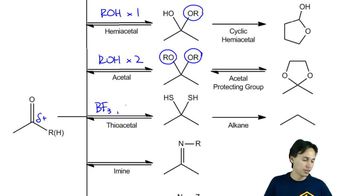
  • Hemiacetal

    An intermediate with both an alcohol and an ether group on the same carbon, typically unstable unless part of a ring structure.
  • Acetal

    A stable functional group with two ether linkages on the same carbon, often used as a protecting group in synthesis.
  • Thioacetal

    A derivative where two sulfur-containing groups replace the oxygen atoms of an acetal, formed using thiols and BF3.
  • Primary Amine

    A nitrogen-containing compound with one alkyl or aryl group, which reacts with carbonyls to yield imines.
  • Imine

    A functional group featuring a carbon-nitrogen double bond, formed from the reaction of a primary amine or ammonia with a carbonyl.
  • Enamine

    A structure containing both a nitrogen atom and an adjacent carbon-carbon double bond, resulting from secondary amine addition to a carbonyl.
  • Protecting Group

    A temporary modification, such as an acetal, used to shield reactive sites during multi-step organic synthesis.
  • Raney Nickel

    A finely divided metal catalyst used to reduce thioacetals to alkanes by breaking carbon-sulfur bonds.
  • Wolf-Kishner Reduction

    A reaction converting imine derivatives, like hydrazones, into alkanes using strong base and heat.
  • Alpha Substitution

    A transformation where a group is introduced at the position adjacent to a carbonyl, often via enamine intermediates and alkyl halides.
  • Geminal Diol

    A molecule with two hydroxyl groups attached to the same carbon, typically formed by water addition to a carbonyl.