Back

Overview of Alpha-Alkylations and Acylations quiz

Control buttons has been changed to "navigation" mode.
1/15
  • What is the main goal of the three synthetic reactions discussed in the overview?

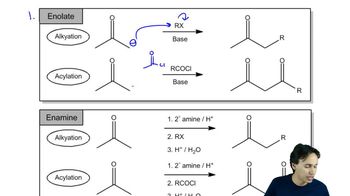
    The main goal is to add an R group to the alpha carbon of a carbonyl compound.
  • What is the first method for alpha carbon alkylation called?

    The first method is called enolate alkylation.
  • How is an enolate formed in enolate alkylation?

    An enolate is formed by treating a carbonyl compound with a base.
  • What type of electrophile does the enolate attack in enolate alkylation?

    The enolate attacks an alkyl halide.
  • What is the difference between alkylation and acylation in these reactions?

    Alkylation adds an R group, while acylation adds a carbonyl group using an acid chloride.
  • What is the second method for alpha carbon alkylation called?

    The second method is called enamine alkylation.
  • How is an enamine formed?

    An enamine is formed by reacting a carbonyl compound with a secondary amine in an acid-catalyzed environment.
  • Why are enamines good nucleophiles at the alpha carbon?

    Enamines have a nucleophilic alpha carbon due to the electron-donating effect of the nitrogen and the double bond.
  • What happens to the nitrogen in the enamine after alkylation or acylation?

    The nitrogen is removed by hydrolysis in an acid workup step.
  • What is the third method for alpha carbon alkylation discussed in the overview?

    The third method is dicarbonyl ester alkylation, such as acetoacetic ester alkylation.
  • Where does the enolate form in dicarbonyl ester alkylation?

    The enolate forms between the two carbonyl groups, where the proton is most acidic.
  • What is the final product after hydrolysis and decarboxylation in dicarbonyl ester alkylation?

    The final product is an alpha-alkylated carbonyl compound.
  • Why are dicarbonyl esters particularly suitable for enolate formation?

    They have the most resonance stabilization and the most acidic alpha proton.
  • How are these three reactions related despite being taught in different chapters?

    They all achieve the same outcome: alkylation or acylation at the alpha carbon of a carbonyl.
  • What is a common feature of the mechanisms for all three alpha-alkylation/acylation methods?

    All involve nucleophilic attack at the alpha carbon, either by an enolate or an enamine.