Back

Overview of Alpha-Alkylations and Acylations definitions

Control buttons has been changed to "navigation" mode.
1/15
  • Alpha Carbon

    The position directly adjacent to a carbonyl group, often targeted for the addition of new groups in synthetic reactions.
  • Carbonyl Compound

    A molecule containing a carbon atom double-bonded to an oxygen atom, serving as the starting point for various alpha-substitution reactions.
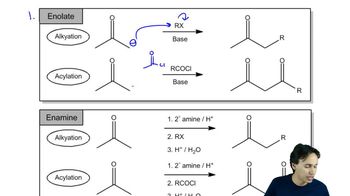
  • Enolate

    A resonance-stabilized anion formed by deprotonation at the alpha position of a carbonyl, acting as a nucleophile in alkylation.
  • Alkyl Halide

    An organic molecule containing a halogen atom bonded to an alkyl group, commonly used as an electrophile in substitution reactions.
  • Acid Chloride

    A reactive derivative of a carboxylic acid where the hydroxyl group is replaced by a chlorine atom, used for acylation.
  • Enamine

    A compound formed by the reaction of a secondary amine with a carbonyl in acid, featuring a nitrogen atom adjacent to a double bond.
  • Nucleophile

    A species with a lone pair or negative charge that seeks out positive centers, such as the alpha carbon in alkylation reactions.
  • Hydrolysis

    A reaction involving the breaking of a bond in a molecule using water, often used to remove protecting groups like enamines.
  • Dicarbonyl Ester

    A molecule containing two carbonyl groups separated by a single carbon, facilitating stable enolate formation for alkylation.
  • Decarboxylation

    A process that removes a carboxyl group as carbon dioxide, often following hydrolysis in dicarbonyl ester alkylations.
  • Resonance Structure

    Alternative Lewis structures for a molecule, showing delocalization of electrons, which stabilizes intermediates like enolates.
  • Synthetic Pathway

    A sequence of chemical reactions designed to construct a target molecule, such as alpha-alkylated carbonyls.
  • Electrophile

    A species that accepts electrons during a reaction, such as alkyl halides or acid chlorides in alpha-alkylation.
  • Secondary Amine

    A nitrogen-containing compound with two organic substituents, used to form enamines from carbonyl compounds.
  • SN2 Attack

    A one-step substitution mechanism where a nucleophile displaces a leaving group, as seen in enolate alkylation.